

THE TIMES OF ISRAEL, Jan 14, 2026
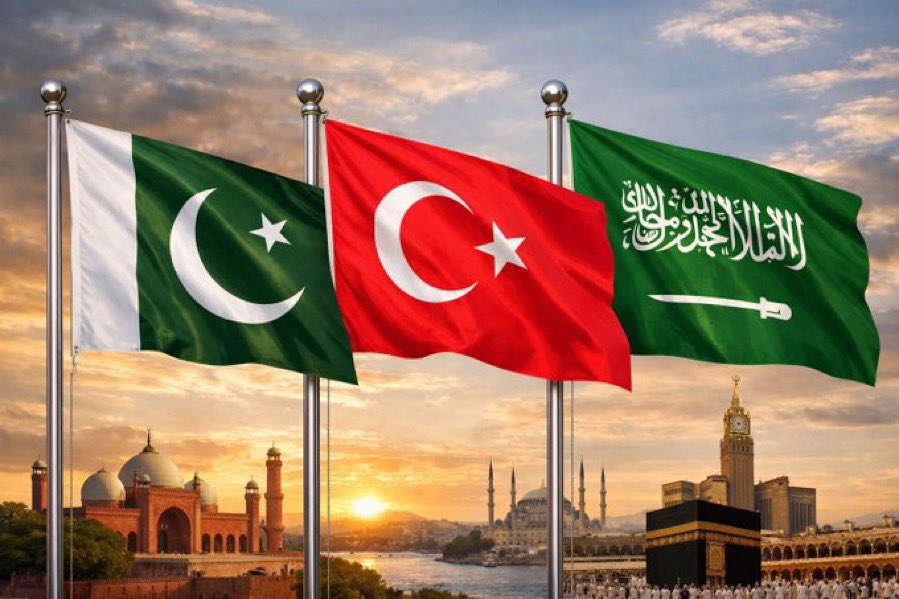
The prospect of a coordinated defense pact involving Saudi Arabia, Pakistan, Turkey, and Egypt would represent a profound shift in the security architecture of West Asia and South Asia. While such an alignment is often framed in benign terms—regional self-reliance, Muslim-world cooperation, or strategic autonomy—the underlying consequences could destabilize already fragile balances, undermine existing deterrence frameworks, and sharply increase risks for Israel and Western interests.
This would not be a symbolic bloc. It would unite four militarily significant states spanning nuclear capability, control of strategic waterways, expeditionary forces, and ideological influence. The danger lies less in formal treaty language and more in the convergence of capabilities, ambitions, and grievances.
Each of the four states brings a distinct and consequential asset to such a pact.
Saudi Arabia contributes financial power, energy leverage, and growing defense procurement ambitions. Pakistan brings nuclear weapons, delivery systems, and decades of experience integrating conventional and asymmetric warfare doctrines. Turkey adds a proven indigenous defense industry—especially drones, missiles, and naval platforms—alongside expeditionary combat experience from Syria to Libya. Egypt controls the Suez Canal, fields one of the region’s largest standing armies, and anchors North Africa militarily.
Combined, these capabilities would create a trans-regional security axis stretching from the Eastern Mediterranean through the Red Sea to the Indian Ocean. Such geographic continuity is unprecedented among Muslim-majority powers and would inevitably challenge the current balance maintained through US alliances and informal regional deterrence.
For Israel, the risks are structural rather than immediate. A coordinated bloc that includes Egypt—a cornerstone of Israel’s regional security since the Camp David Accords—would weaken the strategic predictability on Israel’s southern and western fronts. Even absent open hostility, Egypt’s participation would constrain Israel’s freedom of manoeuvre in Gaza-related contingencies and Red Sea security.
Turkey’s inclusion adds another layer of concern. Ankara’s increasingly confrontational posture toward Israel, combined with its operational reach and defense exports, could translate into indirect pressure via proxy forces, intelligence sharing, or arms transfers hostile to Israeli interests.
Pakistan’s role is the most destabilizing from a deterrence perspective. Even without direct involvement, Pakistan’s nuclear umbrella, doctrinal expertise, and symbolic weight would embolden hard-line actors and weaken Israel’s qualitative military edge by altering regional risk calculations.
West Asia is already navigating overlapping crises: Iran-Israel tensions, Red Sea shipping insecurity, post-Gaza instability, and unresolved conflicts in Syria and Yemen. A new defense bloc would not replace these fault lines; it would overlay them with a competing security architecture.
Such a pact would likely marginalize smaller Gulf states that have pursued pragmatic security partnerships with the West and with Israel under frameworks such as the Abraham Accords. It would also complicate US force posture decisions, dilute NATO’s southern coherence through Turkey, and encourage strategic hedging by Iran, rather than moderation.
Rather than stabilizing the region, this alignment risks accelerating arms races, normalizing military brinkmanship, and creating parallel command structures prone to miscalculation.
The consequences would not stop at the Middle East. Pakistan’s inclusion internationalizes South Asian rivalries. Any elevation of Pakistan’s strategic stature through a Middle Eastern defense pact would inevitably affect India-Pakistan dynamics, embolden revisionist tendencies, and weaken incentives for de-escalation.
India, which has invested heavily in strategic partnerships with Israel, the Gulf, and Egypt, would find itself navigating a more adversarial environment across its western maritime approaches. The Indian Ocean, Red Sea, and Eastern Mediterranean—already linked through trade and energy flows—could become theaters of competitive military signaling.
This is particularly dangerous at a time when global supply chains and energy corridors are under stress.
Beyond hardware, such a pact would carry ideological weight. It risks reviving a bloc-based conception of the Muslim world that blurs the line between state security and religious identity. While none of the four states are ideologically identical, their convergence would legitimize a narrative of civilizational alignment against perceived Western and Israeli dominance.
That narrative, even if not uniformly embraced, would energize non-state actors, undermine moderate regional voices, and complicate counter-terrorism cooperation.
This analysis is not an argument that cooperation among Muslim-majority states is inherently destabilizing. It is a warning that a militarized, exclusionary defense pact—especially one spanning nuclear capability, chokepoint control, and ideological ambition—would erode the delicate deterrence mechanisms that currently prevent wider war.
For Israel, it would compress strategic depth. For West Asia, it would fragment security governance. For South Asia, it would export instability across regions already under strain.
The challenge for Western and regional policymakers is not to react with confrontation, but to recognize the risks early: reinforce inclusive security frameworks, preserve existing peace treaties, and prevent the emergence of rival military blocs that turn fragile regions into interconnected theaters of conflict.
History suggests that when security architectures harden along ideological lines, escalation becomes easier than restraint.
About the Author
Sergio Restelli is an Italian political advisor, author and geopolitical expert. He served in the Craxi government in the 1990’s as the special assistant to the deputy Prime Minister and Minister of Justice Martelli and worked closely with anti-mafia magistrates Falcone and Borsellino. Over the past decades he has been involved in peace building and diplomacy efforts in the Middle East and North Africa. He has written for Geopolitica and several Italian online and print media. In 2020 his first fiction « Napoli sta bene » was published.