

Turkey is weathering the immediate energy shock from the Iran war, but the disruption is exposing the fragility of an import-dependent system vulnerable to prolonged conflict and rising global prices.
The Iran war isn’t causing an energy shortage for Turkey right now. But if the conflict continues, as global supplies tighten and prices rise, Turkey will have to balance short-term stability with longer-term risks.
Global energy markets have been jolted by the war, with Iran effectively closing the Strait of Hormuz, through which roughly a fifth of global oil and liquefied natural gas normally flows. Iranian strikes on energy infrastructure in the Gulf and throughout the region have forced production cuts and export halts.
The war has taken about 8 million barrels per day out of the global supply, according to the International Energy Agency, marking one of the largest disruptions in decades. Oil prices have surged past $100 per barrel, while LNG exports and shipping routes have been disrupted, tightening global gas markets and driving up transportation and insurance costs.
Turkey’s supply buffer
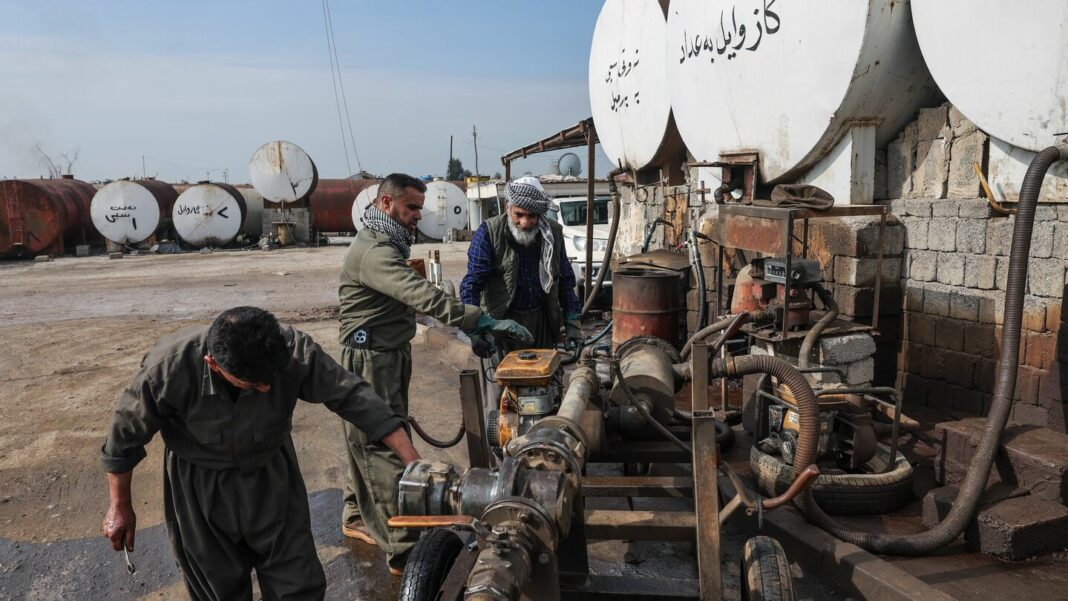
The Iran war has had two direct effects on Turkey. First, Turkey briefly lost one of its oil supply routes earlier this month. Exports from Iraq’s semi-autonomous Kurdistan region to Turkey’s Ceyhan port were halted on March 3, taking about 200,000 barrels per day offline as producers cut output amid rising regional tensions.
Flows resumed on March 18 at around 250,000 barrels per day from the Kirkuk fields via the northern pipeline — a typical level for the route since 2023 — before fluctuating between 170,000 and 250,000 barrels per day after US intervention, according to Al-Monitor’s Amberin Zaman.
On the gas front, Bloomberg reported earlier this week that Iran halted exports to Turkey following Israel’s March 18 strike on the South Pars gas field. Energy Minister Alparslan Bayraktar denied any cutoff but did not directly address whether flows had fluctuated.
Still, he said Turkey’s storage facilities are 71% full and that no short-term disruption is expected as Turkey is entering a seasonal lull in gas demand and relies on storage buffers that start to be replenished each year in September ahead of winter, when consumption rises sharply.
Oguzhan Akyener, director of the Turkey Energy Strategy and Policy Research Center, a think tank in Ankara focusing on energy issues, maintains that the Iran war will not affect Turkey’s gas supplies.
“Turkey has been decreasing its gas purchases from Iran in recent years. It also gets LNG from Qatar, but that constitutes 3.5% of Turkish imports,” he told Al-Monitor.
Even if Iranian gas exports were fully cut off, and with Qatari LNG shipments already significantly disrupted by Iranian strikes, Turkey could offset some of the losses by increasing imports from Azerbaijan and Russia, according to Akyener.
However, despite close energy ties with both countries, limited supply and rising competition could restrict how much additional gas is available and push prices higher for Turkey, which relies on natural gas for 25% of its domestic energy needs.
The disruption is unlikely to create immediate shortages as Turkey enters a low-demand summer period and can rely on existing inventories and alternative suppliers. However, risks could increase if the war extends beyond the summer, as Turkey typically begins refilling its gas storage in September.
Turkey imports about 95% of its natural gas and roughly 90% of its oil, but its gas supply is relatively diversified. Most pipeline gas comes from Russia, Azerbaijan and Iran, while the remainder is imported as LNG from more than a dozen countries, including the United States, Algeria and Egypt, according to Energy Ministry data.
In contrast to Akyener, an adviser to public and private firms in Turkey and neighboring countries told Al-Monitor on condition of anonymity that if the war continues into late 2026, Turkey could face further disruptions.
“Iran’s gas exports to Turkey have already suffered from two problems. For years, the Iranian government has not been able to curb excessive domestic demand and an overly subsidized gas market means Iranians use more than they need,” he said.
The undermined reliability of Iranian supplies has pushed Turkey to hedge against recurring winter disruptions by diversifying its suppliers and increasing its reliance on LNG imports.
Akyener highlighted the resilience of Turkey’s energy sourcing options.
He said that the Iraq-Turkey Pipeline has the capacity to pump higher volumes of oil, pending further deals between Ankara, Erbil and Baghdad amid ongoing talks. “Crude could be transported from Basra to northern Iraq and then through the Kirkuk-Erbil-Ceyhan pipeline, though at higher cost,” he told Al-Monitor.
However, others point out that while the Iraq-Turkey Pipeline has a capacity to carry as much as 1.5 million barrels per day, it is underutilized due to the need for repairs and legal disputes between Ankara, Baghdad and Erbil. The line was shut down in 2023 after the International Chamber of Commerce in Paris fined Turkey for allowing Iraq’s autonomous Kurdistan Regional Government to export Iraqi oil before resuming last year.
Threats to Turkey’s disinflation program
Despite some cushioning from its energy mix, Ankara remains highly exposed to price shocks as it continues its still delicate disinflation program.
After raising interest rates from 8.5% to 50% between mid-2023 and early 2024, Ankara had only recently begun easing them as inflation slowed to below 50% late last year, with the policy rate cut to 37% by January 2026. The central bank paused that easing cycle earlier this month, signaling growing concern over external shocks. Surging energy prices now risk reversing hard-won gains.
Higher oil and gas prices are likely to widen Turkey’s import bill, weaken its currency and push up consumer prices in an economy that relies heavily on energy imports. Each $10 increase in oil prices adds about $3 billion to the current account deficit, around $25 billion in 2025, further increasing external financing pressures.
The inflationary impact is already visible in food prices, one of the most politically sensitive categories, which rose 31.69% annually in February, as higher fuel and fertilizer costs ripple through production and transport chains. A prolonged conflict could force policymakers to keep interest rates elevated for longer or even reverse course.
Beyond inflation, weaker demand from Middle Eastern trading partners and disruptions to regional transit routes could weigh on Turkey’s exports.
The crisis also creates an opportunity for Turkey, reinforcing its ambition to become a regional energy hub. Disruptions to Gulf exports and the effective closure of the Strait of Hormuz have underscored the value of overland pipelines that bypass maritime chokepoints, strengthening Ankara’s case as a reliable transit route to Europe.
While much of the world’s LNG moves by tanker through vulnerable chokepoints like Hormuz, pipeline gas from suppliers such as Azerbaijan and Russia can reach Turkey, and onward to Europe, without relying on sea routes.