
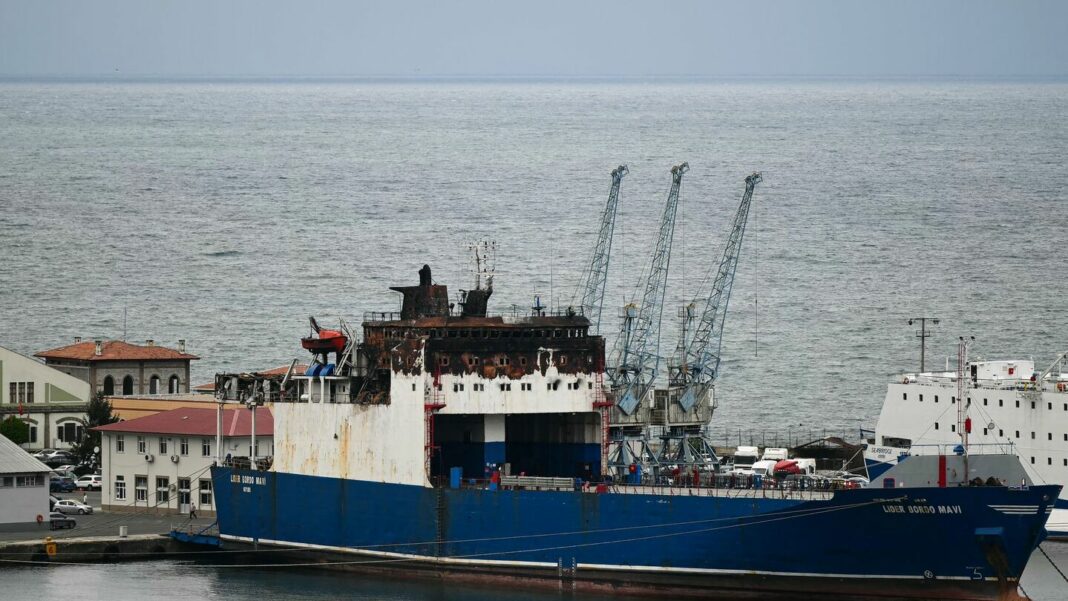

Al-Monitor, October 11, 2026
ANKARA — Several deadly Black Sea attacks on Turkish-linked vessels are testing Turkey’s relations with Russia, but economic interests, active mediation efforts and Ankara’s incentive to preserve its balancing act between Moscow and the West make a rupture unlikely.
Earlier in the week, a series of strikes on commercial vessels owned or operated by Turkish companies resulted in at least two deaths, while 10 additional crew members remained missing and feared dead.
On Monday, the Turkish-owned St. Kitts and Nevis-flagged Royad Mammadov, carrying corn from Ukraine’s Izmail port to Italy, caught fire and sank in Romania’s exclusive economic zone. Romanian authorities said two crew members were killed and 11 rescued.
A day later, sea and aerial drones struck two more Turkish-owned vessels in Bulgaria’s exclusive economic zone, about 70 nautical miles east of the Bulgarian coast. According to the Equasis shipping database, the Togo-flagged Alfa Watan was owned or operated by a Turkey-based company. It sank rapidly with 10 crew members aboard, including nine Syrians.
In the same attack, the Palau-flagged Able, another Turkish-owned vessel carrying wheat, was hit and caught fire. All 18 crew members, including 11 Turkish and seven Indian nationals, were rescued, while two were hospitalized, one with burns and another with a head injury.
Ukrainian President Volodymyr Zelenskyy has directly blamed Russia for all three attacks. Bulgarian Prime Minister Rumen Radev also said Russia may have been responsible for the Oct. 6 attacks on Alfa Watan and Able, based on the vessels’ cargo and routes, while stressing that investigators had not established definitive evidence.
Turkey, meanwhile, has been threading a careful line in its public messaging. Turkish Foreign Minister Hakan Fidan said on Thursday that both Russia and Ukraine were increasing their military operations in the Black Sea ahead of winter, without singling out Moscow.
Turkish President Recep Tayyip Erdogan, meanwhile, stressed the importance of efforts to ensure the safety of navigation in the Black Sea in a phone call with Russian leader Vladimir Putin on Wednesday, according to a Turkish readout of the call.
Hakan Gunes, a professor of international relations at Istanbul University, does not expect the latest attacks to cause a radical deterioration in Turkish-Russian relations.
“Neither side has the luxury of damaging relations — especially in economic terms,” Gunes told Al-Monitor.
Economic pragmatism
For Turkey, Russia remains a major economic partner. Bilateral trade totaled about $49.1 billion in 2025, according to official data released in January 2026. Russia remains one of Turkey’s largest natural gas suppliers, while Russian state nuclear company Rosatom is building Turkey’s first nuclear power plant at Akkuyu on the Mediterranean coast. Tourism is another important link. Russians remained Turkey’s largest foreign visitor group in 2025, with 5.53 million Russian visitors in the first nine months alone, ahead of Germany and Britain.
For Russia, NATO-member Turkey has been an important economic and diplomatic lifeline at a time of growing Western isolation. Ankara has provided military support to Ukraine, including drones and other defense equipment, and closed the Turkish straits to Russian warships’ passage to the Black Sea after the Kremlin’s 2022 full-scale invasion of Ukraine. But it has declined to join Western-led sanctions against Moscow.
Beyond economics, Ankara’s approach is also shaped by maintaining its role as an indispensable mediator between the Kremlin and the West.
“Turkey’s overriding concern is to prevent the Black Sea from becoming another arena of direct NATO-Russian confrontation, while preserving its ability to engage with both Moscow and Kyiv,” Onur Isci, professor and chair of the International Relations Department at Bogazici University and co-author of Red Star: A History of the Soviet Union, told Al-Monitor.
Maintaining Black Sea stability and keeping regional conflicts from drawing in non-littoral states have long been Turkish foreign policy priorities. Turkey controls the Bosphorus and Dardanelles, which connect the Black Sea to the Mediterranean, making it vulnerable to the security and economic fallout of wider conflict. The sea is also vital to Turkish trade, energy flows and shipping.
Between 2022 and 2025, Turkey hosted several rounds of talks between Russia and Ukraine and helped broker agreements on Black Sea grain exports and prisoner exchanges. Ankara is now seeking to build on that mediation role. Last month, AFP reported that Turkey had sent both countries a draft proposal to halt attacks on civilian vessels in the Black Sea and was awaiting their responses.
« Historically, Turkish-Russian relations have survived not because of mutual trust, but because both sides have learned to compartmentalize their strategic disagreements — a formula that is now being tested by the escalation at sea, » Isci added.
Geopolitical leverage
Turkey’s ability to sustain ties with Moscow independently of its NATO allies raises the potential strategic cost to European capitals of alienating Ankara.
As European governments reassess the reliability of US security commitments under the Trump administration and seek to assume more responsibility for the continent’s defense, Turkey’s substantial military capabilities give it added strategic importance.
Together, these factors strengthen Europe’s incentive to manage disputes with Ankara and avoid a deterioration in relations that could encourage closer Turkish alignment with Moscow.
As Turkey’s relations with the United States and Europe deteriorated following the failed 2016 coup attempt and amid disputes over Syria, human rights and the eastern Mediterranean, Ankara strengthened ties with Moscow. This closer relationship led to major strategic projects, including Turkey’s 2017 agreement to buy Russia’s S-400 air defense system despite strong objections from its NATO allies.
These ties also give Moscow an incentive to treat Turkey differently from other NATO members. “At a time when Putin is in tension with the Baltics, Germany, the EU and NATO, he would not want to add tension with Turkey,” Gunes said.
Challenges ahead
Still, Gunes said that Turkey-Russia ties have been on a “downward trajectory” for the past five years, with high-level engagement becoming less frequent and coordination weakening, particularly after the 2020 Nagorno-Karabakh war between Azerbaijan and Armenia, in which Ankara provided extensive military support to Azerbaijan while Russia remained Armenia’s main security partner.
Western sanctions have complicated Turkey’s trade with Russia. In 2024, Turkish banks tightened checks on Russia-related transactions amid US threats of secondary sanctions, disrupting payments for Russian oil and Turkish exports. In 2025, Turkey’s exports to Russia fell roughly 21%, while bilateral trade declined to $49.1 billion from $52.4 billion in 2024, according to official figures.
The result, Gunes argued, is a relationship that remains important but has lost some of its political momentum. Ankara and Moscow continue to keep their disagreements separate from areas of cooperation, which both have strong reasons to preserve.