

Middle East Eye, March 30 2026
Impressed by the TB3’s performance in the Baltic Sea, Italy is considering operating the armed drone from its aircraft carrier
Admiral Giuseppe Berutti Bergotto, chief of staff of the Italian navy, told parliament on Tuesday that Italy had been paying particular attention to unmanned systems, including drones.
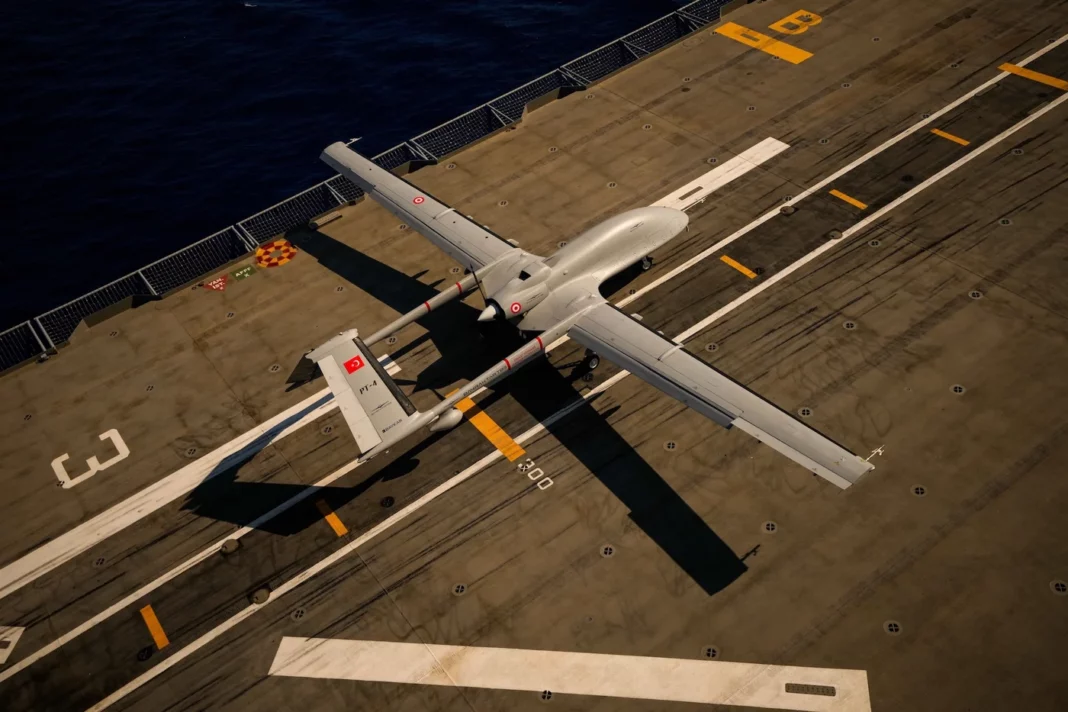
After showing footage of Baykar’s Bayraktar TB3 taking off from the Turkish light aircraft carrier TCG Anadolu, Bergotto said the navy was interested in acquiring the « somewhat complex » system.
« As you know, Baykar has signed a cooperation agreement with Leonardo; therefore, the acquisition would be through Leonardo, and it can be integrated aboard the aircraft carrier Cavour, » he said, referring to a partnership agreement signed last year between the Italian and Turkish defence companies that allows them to collaborate on projects such as the TB3.
« This allows both surveillance and the possibility of carrying armament, » he added.
The Italian aircraft carrier Cavour, the flagship of the Italian Navy, can carry F-35 fifth-generation fighter jets capable of vertical takeoff, as well as military helicopters.
Turkey’s TCG Anadolu is a similar vessel. It was initially designed to carry F-35s, but after Ankara was removed from the programme, the ship began being used to host TB3 drones instead.
Both ships are also classified as Landing Helicopter Docks (LHDs) and have been adapted to carry aerial assets.
Sources familiar with the matter told Middle East Eye that the TB3’s recent performance during Nato’s Steadfast Dart 2026 military exercises impressed European allies, including the Italians.
The TB3s were able to autonomously take off from and land on the TCG Anadolu in subzero temperatures, while other allied aircraft were unable to operate from ships in the Baltic Sea in February. The drones also successfully fired missiles at targets during the drill.
If completed, the sale would further validate the capabilities of the TB3, as another of Turkey’s Nato allies would purchase and operate the platform.
Riccardo Gasco, an analyst affiliated with the IstanPol Institute, said that for many European navies, the TB3 may represent the quickest available answer to a capability gap that their domestic programmes have failed to fill.
“Europe has spent years discussing carrier-capable unmanned systems without fielding one,” he told MEE.
“Turkey already has one, it works, and it is now accessible through an Italian industrial partner. On a continent that is suddenly serious about defence, that may be exactly what many European states have been waiting for.”
Gasco said that, thanks to the Baykar-Leonardo partnership, Italy would be filling a significant capability gap in carrier-based unmanned strike systems that European navies have long struggled to address.
“That is a qualitatively different relationship, and one that will inevitably carry weight in how Rome approaches Ankara on a broader set of security and foreign policy questions,” he said.
The drone is an updated version of the well-known Bayraktar TB2, which proved highly effective during the wars in Ukraine, Libya and Syria.
The Bayraktar TB3 can carry a 280kg payload and is designed to carry more than six laser-guided munitions, primarily air-to-ground smart munitions, missiles, loitering munitions and supersonic missiles.
Indonesia became the first foreign buyer of the platform in February.
During the same hearing, Admiral Bergotto said that the navy views systems like the TB3 as « force multipliers » because they enhance both operational effectiveness and surveillance capability.
Gasco said that the Turkish – Italian partnership forces a question the EU has long avoided: whether it needs to integrate Turkey into the union’s strategic defence plans rather than rely on a patchwork of bilateral arrangements.