
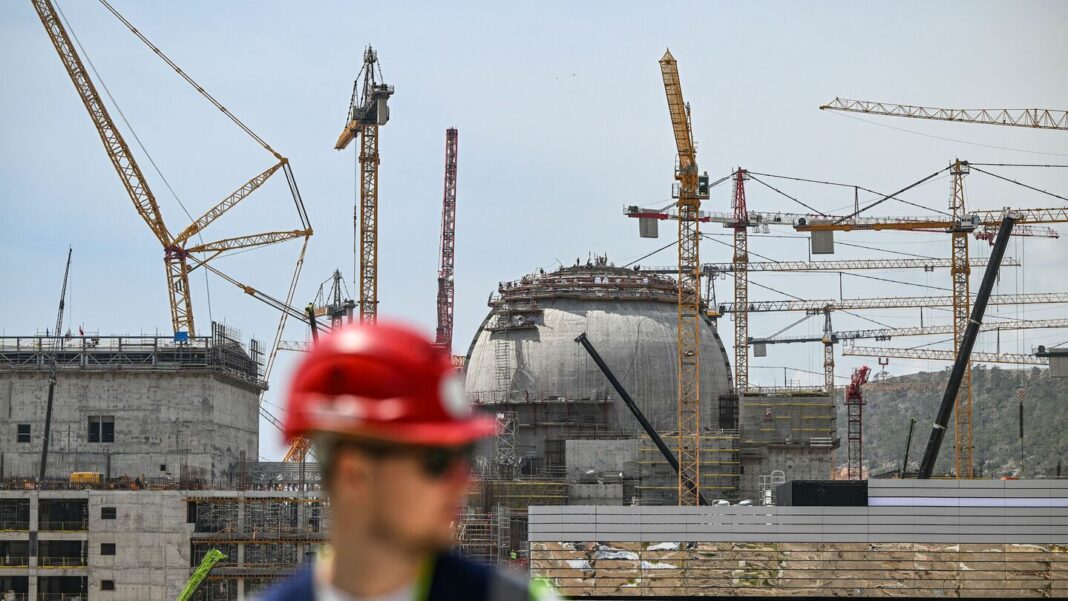
 facility on the country’s southern coast expected to begin initial operations in 2026 — three years behind the original target. )
Though the region’s nuclear energy boom was supposed to be in full swing by 2025, key projects have all fallen behind schedule or fizzled entirely — but new momentum could be emerging.
Turkey’s nuclear debut may finally be in sight: In late December, Energy Minister Alparslan Bayraktar announced that Turkey had secured $9 billion in new Russian financing for the Akkuyu nuclear power plant, with the 4.8 gigawatt (GW) facility on the country’s southern coast expected to begin initial operations in 2026 — three years behind the original target.
The news offers a snapshot of the slow progress that has come to define the Middle East’s nuclear energy push amid persistent challenges. Akkuyu, if fully commissioned by 2028 as planned, would become only the third operational nuclear power plant in the region, and it is expected to supply roughly 10% of the country’s electricity.
Bayraktar’s announcement also caps a dramatic year for nuclear energy in the Middle East, as 2026 shapes up to be a pivotal test of whether the region can close the gap between ambition and delivery. By 2025, the region’s nuclear energy boom was supposed to be in full swing, but projects in Egypt, Turkey and Iran have all fallen behind schedule, while others planned in Saudi Arabia and Jordan never got off the ground.
Each missed milestone reflects different challenges — sanctions, financing, geopolitics, technical delays — but together they illustrate how difficult it remains to translate costly nuclear aspirations into electrons on the grid.
Yet 2025 also produced signs of major momentum in the Middle East. In November, Saudi Arabia completed negotiations with the United States on civil nuclear cooperation, potentially reigniting the kingdom’s long-stalled nuclear plans. Now, Riyadh’s next steps will loom large in 2026, with the Gulf power potentially poised to finalize a heavily scrutinized nuclear agreement with Washington.
Despite delays, Egypt also advanced construction at its first plant this year amid efforts to launch operations by 2028, and regional players are aspiring to launch new projects. In September, Iran announced a new $25 billion agreement with Russia’s state nuclear company, Rosatom, to construct four new nuclear plants, even as conflict and sanctions will likely complicate these plans.
That said, 2025 also saw the Middle East on the edge of a nuclear catastrophe during the June war between Israel and Iran, which highlighted the physical risks associated with nuclear infrastructure in a volatile region. Reports — which were later denied — that Israel had struck Iran’s Bushehr plant briefly revived long-standing fears about radioactive fallout contaminating Gulf air and water.
That didn’t come to pass, but 2025 demonstrated the full range of nuclear energy’s potential and perils in the region — from supply-chain vulnerabilities to wartime risks and proliferation fears.
Prestige power
Nuclear energy’s appeal in the Middle East is well established. Governments want reliable baseload power to meet surging demand, reduce reliance on fossil fuels and bolster energy security. Prestige plays a role, too, with governments seeking to join the exclusive club of nuclear-powered nations.
The Middle East’s first civilian nuclear power plant, Iran’s 1 GW Bushehr facility, came online in 2011 amid growing sector momentum in the region. But it took roughly a decade for the next major project to be completed. In 2024, the United Arab Emirates delivered a major milestone, when Abu Dhabi’s $20 billion 5.6 GW Barakah Nuclear Energy Plant fully connected to the national electricity grid. Currently, five reactors are operational in the region, with construction underway on additional ones in Turkey, Egypt and Iran.
As of 2018, the US Energy Information Agency (EIA) noted that nuclear electricity generation capacity in the Middle East was expected to increase from 3.6 GW in 2018 to 14.1 GW by 2028. Based on current timelines for projects underway, it appears that target will be missed. Currently, the IEA projects nuclear capacity in the region will triple by 2035 to reach 19 GW.
Turkey’s Akkuyu project best captures the region’s mixed reality. Launched under a 2010 agreement with Rosatom, the $20 billion plant has struggled with delays, cost overruns and sanctions-related complications since construction began in 2013.
Western restrictions on Russia after its invasion of Ukraine in 2022 disrupted financing and procurement, forcing Rosatom to scramble for alternative suppliers and leaving significant funds frozen abroad. « Unfortunately, a significant amount of money required for the completion of the plant remains frozen in a certain country,” Anton Dedusenko, chairman of Akkuyu Nuclear, told the Turkish publication Daily Sabah in December.
The new $9 billion financing package is meant to ease those pressures and keep the project on track for a 2026 start date. But sanctions risks could still complicate completion of Akkuyu’s remaining units.
Egypt faces a similar balancing act. Its 4.8 GW El-Dabaa nuclear plant, also being built by Rosatom, was originally expected to see its first reactor operational by 2022. That target has slipped to the second half of 2028 amid persistent challenges. Still, Cairo marked tangible progress in 2025, including the installation of a reactor pressure vessel in November — signs that the project has moved into more advanced construction stages.
Egypt has plenty riding on El-Dabaa. Chronic power shortages, declining gas output and reliance on Israeli gas imports have heightened the need for Cairo to diversify the country’s energy mix in coming years. Nuclear power offers a long-term energy security solution, but further delays at Dabaa could increase pressure on an already strained energy system that’s creating political risks for the government.
Enter Saudi Arabia
Saudi Arabia’s nuclear energy ambitions are nothing new: In 2012, Saudi Arabia announced plans to build 16 nuclear power reactors by 2032, a target later pushed to 2040. But this year may have delivered a major breakthrough with the completion of US-Saudi negotiations on civil nuclear cooperation — a long-sought step toward enabling US companies to sell nuclear technology to the oil-rich Gulf state.
What remains unresolved is the core issue that has stalled talks for years: nonproliferation. A so-called Section 123 agreement under US law — generally required for significant American nuclear exports — typically restricts uranium enrichment and fuel reprocessing. Saudi Arabia has long resisted those limits, per reports, while flirting with Chinese cooperation in recent years to add pressure on Washington.
US Energy Secretary Chris Wright has said the new framework excludes enrichment, but the absence of a finalized 123 agreement leaves room for uncertainty. If Saudi Arabia somehow ultimately secures more permissive terms from the Trump administration, it will reshape nonproliferation norms more broadly. Whether US-Saudi nuclear cooperation advances further will be a key storyline to watch in 2026.