

Middle East Eye, 16 February 2026
Saudi Arabia is toying with Turkey as it pursues advanced F-35 warplanes and forges new partnerships to check Israel and UAE
Saudi Arabia’s bid to diversify its weapons partners is rankling the Trump administration, which sees deals with countries like Turkey potentially cutting into the US’s slice of the kingdom’s arms market, current and former US officials have told Middle East Eye.
Crown Prince Mohammed bin Salman was feted at the White House in November when US President Donald Trump announced the kingdom would be buying advanced F-35 warplanes and rolled out a major strategic defence agreement.
But more recently, US officials operating under Trump’s deal-making diplomacy agenda have sought clarity from Saudi Arabia about its arms deals talks with other regional countries.
Following pushback from Washington, Saudi Arabia assured the US that it would not be purchasing Pakistan’s JF-17 fighter jet after reports emerged it could convert billions of dollars in loans to Islamabad for the warplane, the US official told MEE.
But US officials have not received similar guarantees from Saudi Arabia about its potential participation in Turkey’s next-generation Kaan fighter programme.
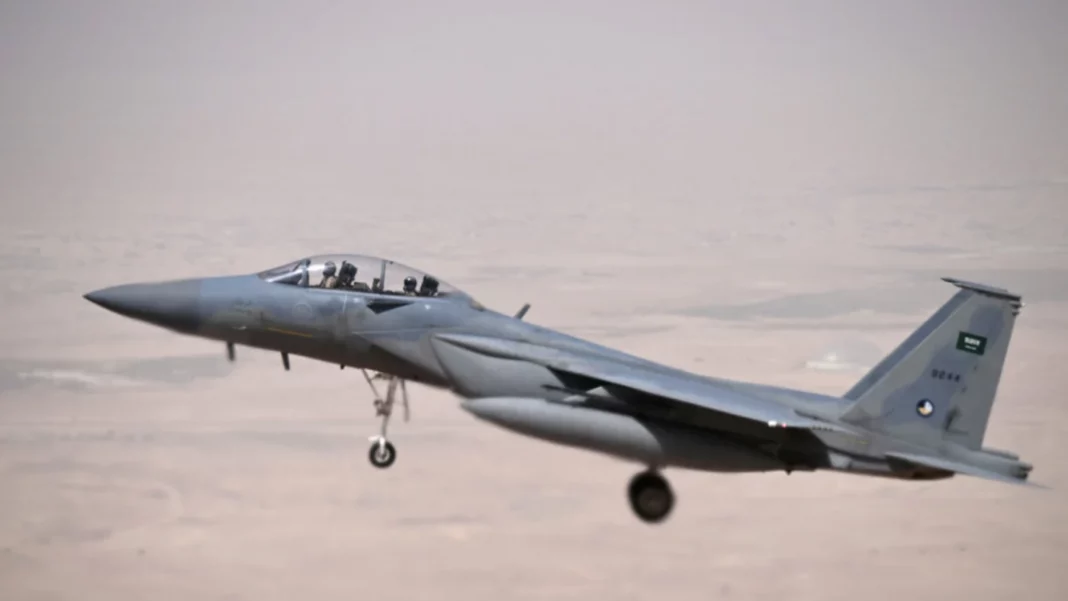
“I don’t see where the Turkish fighter fits into the Saudis’ repertoire, which is extensive already. They have the best F-15s on the entire planet, better than the Americans. The Euro Typhoon is good, and they are about to get the F-35s,” Bilal Saab, a former senior defence official in the Trump administration, told MEE.
A US official familiar with the matter said the Trump administration does not view the potential deal as replacing the F-35, but as Saudi Arabia leaving cash on the table for more purchases from the US.
“The message to the Saudis has been, ‘What need do you feel is not being met by the US, that you need to go to Turkey for the Kaan?’” the official, speaking on condition of anonymity, told MEE.
“This administration wants to be the sole provider, putting American exports first,” the source added.
Multipolar Middle East
Current and former Arab and US officials who spoke with MEE do not predict a major fallout, but the US’s pushback underscores how Trump’s diplomacy, based on zero-sum economics, is rubbing up against a more multipolar Middle East.
“Saudi Arabia’s interest in the TAI (Turkish Aerospace Industries) Kaan is about having more choices, not replacing the United States, because this isn’t possible,” Hesham Alghannam, the director general of strategic studies and national security programmes at Naif Arab University in Riyadh, told MEE.
“But if the US administration sees arms sales as a competition, it might view this move as a sign that Saudi Arabia is drifting away.”
‘What if the Israelis make a really big fuss about this?’
– Cinzia Bianco, European Council on Foreign Relations
Cinzia Bianco, a Gulf expert at the European Council on Foreign Relations, told MEE, “There is room for misunderstanding.”
Turkish President Recep Tayyip Erdogan said during a visit to Saudi Arabia in February that a joint investment for Kaan “could be signed at any moment”. A model of the Kaan was displayed at the World Defence Show in Riyadh this month, emblazoned with a Saudi flag.
Mehmet Demiroglu, TIA’s general manager, told Breaking Defense last week that a deal with Saudi Arabia could see between 20 and 50 warplanes made for the kingdom.
Defence experts say that Saudi Arabia could buy both the F-35 and the Kaan. Although the latter is billed as a Turkish warplane, it still requires an F110 engine made by General Electric. The sale has been under discussion for years, but has yet to move through Congress.
There are tactical and broader strategic reasons why Saudi Arabia is toying with Turkey’s Kaan as it looks to close a deal with the Americans.
Trump publicly promised Saudi Arabia it would be allowed to purchase warplanes as sophisticated as Israel’s F-35s. The F-35 can be ordered from Lockheed Martin like a car: “fully-loaded” or in a less advanced variety.
Israel has long maintained an effective veto on the sale of advanced US weapons to Middle Eastern states to preserve its own “Qualitative Military Edge” against its neighbours.
Israeli Prime Minister Benjamin Netanyahu said in November that US Secretary of State Marco Rubio promised that Saudi Arabia would receive inferior F-35s to Israel’s.
“I don’t think that makes you too happy,” Trump told the Saudi crown prince at the White House, admitting Israel’s lobbying.
‘A diplomatic ploy’
The Trump administration is effectively caught between pro-Israeli lobbying and its desire to boost weapons exports to the Gulf. MEE revealed the Trump administration has been briefing lawmakers and their staff on how the sale of F-35s will impact QME, potentially reassessing the metrics.
“I see this as a diplomatic ploy to try to get the right kind of specifications on the F-35,” Saab said. “The Saudis and other Gulf states use arms sales as a foreign policy tool, less so an attempt to build military capabilities.”
“The incentive here is not military in nature for a better capability. For the Saudis, this is about ‘How do we get a better deal from the Americans?’” he added. “And quite frankly, it works.”
‘The pace of US engagement on deep, structured co-production and transfer remains perceived as slower than Saudi aspirations’
– Hesham Alghannam, Naif Arab University
Saudi Arabia has a track record of flirting with the US’s competitors to extract concessions.
During the first Trump administration, the kingdom toyed with the Russian S-400 before acquiring the Thaad air defence system, provoking an angry response from the Trump administration at the time, the current and former US officials told MEE.
But Turkey is offering the kingdom something of value that the US has yet to: co-production and tech transfers.
Crown Prince Mohammed bin Salman’s Vision 2030 calls for 50 percent of the kingdom’s defence spending to be on locally produced items.
“[To] be frank…the pace of US engagement on deep, structured co-production and transfer remains perceived as slower than Saudi aspirations, which will certainly prompt Riyadh to continue exploring partnerships that are often more flexible on local production and knowledge sharing,” Alghannam told MEE.
“If Saudi Arabia feels pressured to choose one partner over others…that kind of pressure might push Riyadh to strengthen ties with alternative suppliers instead,” he added.
‘A big Israeli fuss’
Bargaining aside, Saudi Arabia’s talks with Turkey are also taking place amidst a rapidly changing geopolitical landscape, which Washington has at times been slow to notice.
Crown Prince Mohammed bin Salman jolted policy wonks when he lobbied Trump directly against the UAE in November for its role in Sudan’s civil war. MEE was the first to report the kingdom’s plans.
Since then, Saudi Arabia has moved to evict the UAE from Yemen. It is backing the Sudanese army, alongside Egypt and Turkey, to defeat the UAE’s allies, the Rapid Support Forces paramilitary group.
As Saudi Arabia cooperates with Pakistan, Turkey, Qatar, and Egypt, the bonds between the UAE and Israel are becoming starker.
Saudi Arabia could be using its wealth to shore up this new bloc through arms purchases.
But Bianco, at the European Council on Foreign Relations, told MEE Riyadh is wary that the “promises” Trump made on the F-35 will not materialise, and are susceptible to Israel’s allies in Washington.
Trump himself has not waded into the Gulf rift, but US Senator Lindsey Graham, a key ally of the president, lambasted the Saudi crown prince at the Munich Security Conference on Friday.
“The Saudi F-35 deal is now divorced from normalisation with Israel. Does it end up like the Emirati F-35’s that never materialised because of other conditions? In the UAE’s case, it was China; in the Saudi case, Israel. What if the Israelis make a really big fuss about this?” Bianco said.
“The Saudis will take the F-35 even if they receive a lesser version than Israel. They won’t be happy about it, but they will take it,” she added.