
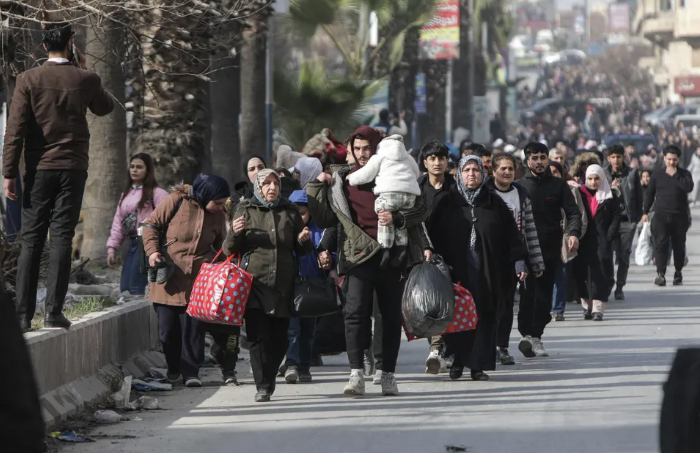

Syrian government forces shelled Kurdish neighborhoods in Aleppo on January 7, 2026, killing at least seven and displacing over 3,000 civilians to flee through evacuation corridors. The Syrian army declared the Sheikh Maqsoud and Ashrafiyeh districts—home to tens of thousands— »legitimate military targets. »
The attack came hours after, Damascus announced a U.S.-brokered intelligence-sharing mechanism with Israel in Paris. Turkish Foreign Minister Hakan Fidan had met his Syrian counterpart on the summit’s sidelines just hours earlier.
The timing is not coincidental. It fits a pattern that has defined Ahmed al-Sharaa’s presidency one year after the Assad regime’s collapse—and one that carries direct implications for energy transit routes, reconstruction tenders, and regional stability calculations.
The Diplomatic-Repression Sequence
Three variables define Sharaa’s governance model. First, high-level diplomatic engagements consistently precede internal escalations. Second, external powers receive security concessions while domestic minorities face military operations. Third, the model delivers tactical control but erodes the internal cohesion required for durable stability.
The sequence has repeated across minority regions throughout 2025. Sharaa’s November White House visit with President Trump unlocked sanctions relief and international legitimacy. Within weeks, protests in Alawite coastal areas turned deadly. Human Rights Watch documented over 1,400 killed in March operations alone—targeted killings, looting, and mass graves in Latakia, Tartous, and Hama governorates.
A December 22 high-level Turkish delegation visited Damascus—Foreign Minister Fidan, Defense Minister Güler, and intelligence chief Kalın met Sharaa at the People’s Palace. Clashes intensified in Aleppo the same day, where Turkey-backed groups pressed Kurdish positions. The January 2026 Paris talks produced de-escalation agreements with Israel—and sideline coordination with Ankara. Aleppo’s Kurdish districts were then declared military zones.
The pattern: diplomatic progress abroad, military operations at home.
External Shield, Internal Blade
Sharaa has constructed what analysts term a « strong regime within a weak state. » The administration cedes ground abroad to secure freedom domestically: buffer zone acceptance and intelligence coordination with Israel in the south, deference to Turkey-backed forces against Kurds in the north.
These arrangements satisfy neighbors’ security priorities. Border quiet matters more to Ankara and Tel Aviv than Syrian sovereignty. In exchange, Damascus faces muted criticism of internal operations.
Turkey’s repeated engagements—Ankara in January 2025, Istanbul in May, Damascus in December, Paris in January 2026—correlate directly with pressure on Kurdish forces. Each diplomatic milestone preceded or accompanied anti-SDF operations. The Kurdish-controlled areas contain approximately 70% of Syria’s pre-war energy resources. Their status shapes any reconstruction calculus.
The strategic logic mirrors survival patterns of past regional autocrats. A regime that poses no external threat invites no intervention. Domestic rivals—Kurds, Alawites, Druze—represent the primary existential challenges to centralized rule. External legitimacy enables repression at home.
The Azerbaijan Exception
July 2025 revealed the model’s single limit. Sharaa’s govermnent held sideline talks with Israeli officials in Baku during his Azerbaijan visit—his first direct contact since taking power.
Damascus apparently read the encounter as tacit permission for action in Suweida. Days later, government forces deployed against Druze armed groups amid escalating sectarian clashes. Reports revealed that government-aligned troops committed atrocities, including extrajudicial killings, forced humiliations, and looting.
Israel responded differently than expected. Airstrikes hit Syrian convoys heading south, struck the Defense Ministry and presidential palace in Damascus. Jerusalem reinforced Golan positions and signaled direct protection for Druze communities—many of whom share ethnic ties with Israel’s 150,000 Druze citizens.
The crackdown backfired. Over 1,000 died in Suweida violence, mostly Druze civilians. Sharaa secured a fragile ceasefire only after Israeli intervention exposed the costs of misreading his neighbors’ red lines.
The pattern clarified: external compliance buys domestic latitude, but only within bounds set by Tel Aviv. The Druze exception proves the rule—when repression crosses Israeli red lines, the paper tiger externally tears.
Implications for Regional Exposure
The model delivers short-term control but undermines the internal cohesion reconstruction requires. Corporate strategies assuming rapid normalization overlook these dynamics.
Energy transit routes through Syria remain vulnerable. The country sits astride potential corridors connecting Gulf producers to Mediterranean export terminals. Sustained fragmentation—or renewed conflict cycles—affects insurance premiums, infrastructure timelines, and supply chain reliability for any firm with Levant exposure.
Migration spillovers carry secondary risks. Each escalation cycle displaces populations toward Turkey, Jordan, and Lebanon. ISIS remnants already exploit the chaos—a December 2025 ambush on U.S. forces highlighted persistent security gaps.
Western capitals continue engagement, conditioning aid loosely on minority protections that remain unenforced. The gap between diplomatic rhetoric and operational reality widens with each cycle.
Strategic Takeaway
Boardrooms with Middle East exposure should monitor the divergence between diplomatic progress and minority treatment as the clearest leading indicator of Syria’s trajectory.
The most likely path forward involves continued diplomatic engagement without meaningful minority protection conditionality, internal repression persisting under external cover, and fragmentation deepening gradually. Reconstruction timelines will extend indefinitely under these conditions.
The Azerbaijan episode proved that Sharaa misread his external partners once. Whether he learns from that miscalculation—or repeats it with Kurds rather than Druze—will determine whether Syria’s transition produces durable stability or institutionalized fragmentation.
For now, external support enables the internal blade. The Druze exception marks the single boundary. Everything else remains open terrain.