

Turkey’s expanding military footprint in Somalia is drawing criticism amid deepening federal-regional tensions, with Ankara denying it is taking sides.
Turkey’s growing military presence in Somalia, aimed at supporting the fight against al-Shabab and expanding its influence in the Horn of Africa, has prompted criticism from some Somali actors over its perceived role in domestic political dynamics.
Turkey has been caught in Somalia’s deepening rift between the federal government and regional authorities, as its expanding military role draws scrutiny. Critics, including regional officials and some lawmakers, accuse Ankara of backing Mogadishu in internal power struggles, pointing to the alleged use of Turkish-supplied weapons in confrontations between federal and local forces. Ankara, in turn, rejects the claims, insisting it does not take sides and is focused on preserving Somalia’s territorial unity while strengthening its security forces. Experts say the perception gap reflects Somalia’s polarized politics, where Turkey’s security-driven support, aimed at safeguarding its own interests and influence in the Horn of Africa, is often interpreted through shifting alliances rather than a fundamental change in its policy.
Disputes between Mogadishu and provincial governments have intensified in recent weeks, driven by disagreements over constitutional changes that are seen by some regional leaders as aimed at centralizing power.
In mid-March, Somalia’s Southwest State said it was suspending ties with the federal government, accusing it of interference in regional governance and security affairs, while Mogadishu rejected the claims and moved to assert control.
The standoff led to the federal government on Monday to take over Southwest State’s regional capital, Baidoa, roughly 150 miles northwest of Mogadishu. The move prompted the resignation of regional President Abdiaziz Hassan Mohamed Laftagareen.
Turkey caught in the rift
Before Laftagareen’s stepping down, the Southwest State administration accused the federal government of using Turkish-made weapons in the confrontation and called on Ankara “to refrain from supporting the offensive against the people of the [Southwest].”
Possible use of Turkish military equipment has also drawn criticism within Somalia’s federal parliament, where some lawmakers, including Abdi Ismail Samatar, a long-time critic of foreign intervention in Somalia, have accused Ankara of overstepping its role.
Samatar called Somali President Hassan Sheikh Mohamud a “minion” of Turkey, which, he claimed in a post on X, “is focused on establishing a client state so it could loot whatever natural resources and strategic value our country has.”
Ankara, in turn, argues that it does not take sides in the internal political rivalries among legitimate Somali factions and is instead focused on keeping the country in one piece while also keeping the al-Qaeda-affiliated group al-Shabaab at bay.
“Before the 2022 elections, many Somali factions and even Hassan Sheikh Mohamud was accusing us of backing then incumbent president, Farmaajo [Former Somali President Mohamed Abdullahi Mohamed], but he won nonetheless,” a Turkish national security official told Al-Monitor. “Now Hassan’s opponents are accusing us of the same thing,” he added.
Expanding footprint
The criticism of Turkey’s involvement in Somalia’s internal affairs comes as Turkey has been steadily expanding its military presence in Somalia. Earlier this year, three Turkish F-16s were seen taking off from the city’s airport, marking Ankara’s first forward stationing of manned combat aircraft in Somalia.
A year ago, Turkey placed its powerful Turkish Aerospace T-129 ATAK helicopters and the twin-engine Baykar Akinci drones in Mogadishu.
In addition to air assets, Turkey has dispatched M48 and M60 Patton main battle tanks to Somalia, the country’s Radyo Kulmiye, a radio station and website, reported in February..
In March, Ankara also dispatched its first drilling ship to Somali waters following Turkish seismic research for hydrocarbon resources off the coast of Somalia between 2024 and 2025.
Turkey’s Defense Ministry also announced earlier this month that the Turkish Navy would deploy three warships to operate in the Gulf of Aden off the Somali coast and in the Arabian Sea in support of Turkish offshore drilling activities in Somali waters. The state-run Anadolu Agency reported that two drilling ships will begin operations later this month.
Safeguarding Turkish interests
Experts who spoke to Al-Monitor pointed out that Turkey is building on its more than 15-year presence in Somalia and protecting its strategic investments — among them are a planned spaceport, a naval base and oil and gas extraction projects. Somalia also hosts one of Turkey’s largest overseas military bases, which secures a strategic military foothold for Ankara in the Horn of Africa.
Kaan Devecioglu, coordinator for North and East African Studies at the Ankara-based think tank ORSAM, said the increasing deployment does not signal a shift in Turkey’s longstanding approach, which has focused on training, advising and equipping Somali forces rather than engaging in direct combat operations.
“Turkey’s strategic investments in Somalia and the two countries’ cooperation are deepening every day,” Devecioglu told Al-Monitor. “Rather than a change in Turkey’s position, I think this is a natural development to ensure the security of these investments.”
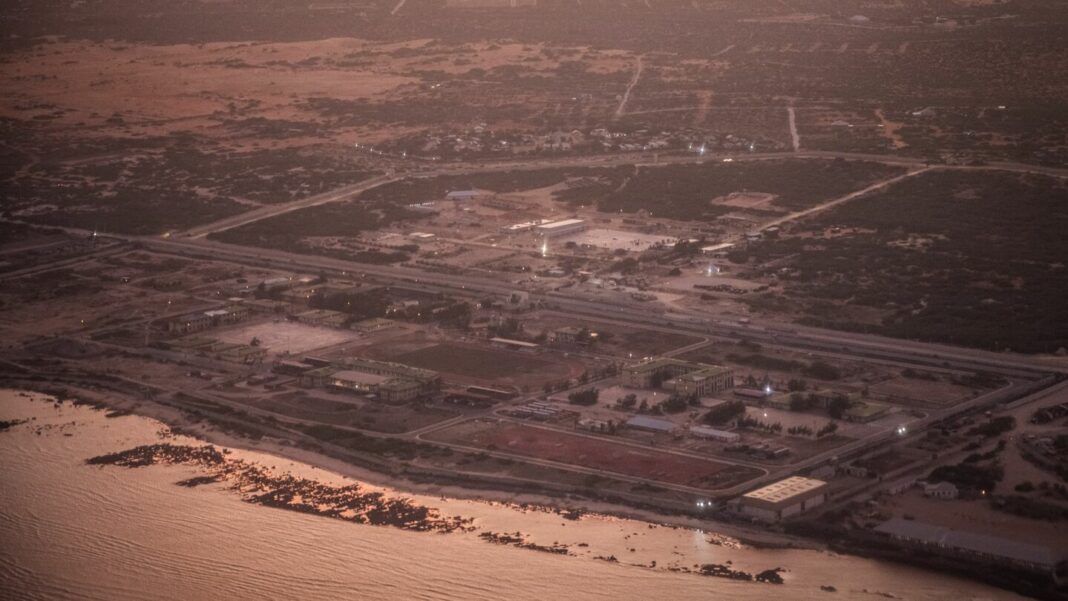
The TURKSOM Military Training Base, which was opened in 2017 in Mogadishu, trains thousands of Somali National Army troops and anchors Ankara’s long-term security partnership with the federal government, while giving Turkey a sustained military foothold in the Horn of Africa near key Red Sea and Indian Ocean shipping lanes.
Turkey’s increasing deployment comes at a time when Somali forces intensify their counter-offensive against al-Shabab.
According to Yusuf Hassan, an independent consultant and fellow at the City University of Mogadishu’s Research Institute, there are two main reasons for the increasing deployment.
“First, African Union peacekeepers are preparing to leave Somalia, and Turkey is stepping in to make sure Somali forces are ready to take over,” Hassan told Al-Monitor.
“Turkey’s increased military presence is designed to protect [its] investments and help create the security needed for Somalia to rebuild,” he said.
Since 2007, successive AU missions helped push al-Shabab out of Mogadishu. Beginning in 2022, however, the AU initiated a phased drawdown, formally ending the mission in December 2024 and replacing it with the lighter AU mission in 2025. More than 12,000 troops deployed in that mission are also expected to withdraw fully in 2026.
With respect to Turkish military equipment’s role in the federal government’s takeover of the Southwest, Hassan said Turkish role is often “misunderstood.”
“The overwhelming majority of Somalis view its involvement positively, seeing it as a key driver of state-building progress,” he said. “Some in the opposition interpret Turkey’s support for the government as personal backing for the president, but that misreads the situation.”
Echoing the Turkish official’s points, Hassan added, “The current president himself made similar accusations when he was in opposition, highlighting how such claims tend to shift with political positioning.”
Israel-Somaliland connection
Internal rifts among provincial governments and the federal Somali forces also come amid the growing rivalry in the Horn of Africa, which intensified after Israel in December announced its recognition of Somaliland. The breakaway region declared independence from Somalia in 1991 and has operated autonomously ever since, though it remains unrecognized by any other country except Israel.
Following the Israeli move, Turkey last month formally designated Somalia’s territorial integrity a national security priority. While Turkey views Israel’s recognition of Somaliland as a potential threat to Somalia’s territorial integrity and a destabilizing development for the region, Turkish officials and experts say the recent increase in Ankara’s military deployment is not directly tied to the Israeli move.
“What we’re dealing with in Somalia is a bunch of armed religious fanatics who want to make a difficult situation unbearable — just as they have done in other places,” a retired Turkish national security official told Al-Monitor on condition of anonymity. “By that I mean al-Shabab, not Israel, » he added.
Al-Shabab seeks to overthrow the federal government and impose a strict interpretation of Islamic law. Despite losing control of most major urban centers, the extremist group remains financially resilient through taxation networks and extortion, enabling it to sustain a long-running insurgency against the Somali state and AU-backed forces.
Hassan believes increasing Turkish military deployment in and around Mogadishu was in the works long before the Israeli recognition of Somaliland.
“This isn’t about Israel or Somaliland. It’s about a partnership that has finally reached this new level of cooperation,” he said.