

As legitimacy erodes, citizens stop fearing institutions and begin confronting them
The Times of Israel, January 1, 2026
Power rarely collapses aloud. It erodes quietly, when currencies stop persuading, ballots stop convincing, and obedience costs more to extract each day. Iran’s streets matter not for their noise, but for the trust that withdrew before the crowds appeared. Turkey is closer to this stage than it admits. Different systems, same exposure: coercion replacing consent, performance replacing legitimacy. When unity must be manufactured rather than earned, regimes are no longer governing. They are containing pressure. Close those exits, and pressure rises faster than fear can contain it.
Regimes do not fracture when crowds gather. Crowds gather after trust collapses – the trust that lets a society price bread, honor contracts, accept verdicts, and believe tomorrow will resemble today. In Iran, the unrest of late 2025 began not with ideology or leadership, but with arithmetic. An exchange rate that outran memory turned daily life into chance. Merchants moved first. The bazaar closed not in mourning, but in disbelief. When prices cannot be quoted with a straight face, the state is no longer facing dissent. It is under audit.
Iran has known anger before. What is new is the speed with which economics became politics. Earlier waves were managed as fevers: isolate streets, silence screens, arrest the visible, frighten the invisible, wait. This time the first movers were different. The bazaar is not symbolism; it is infrastructure. Once it moves, instability synchronizes. That is why the regime rushed to rebrand the unrest as “professional” or “sectoral”. The language was defensive. Narrow grievances can be negotiated. National ones force a choice between reform and repression at existential scale.
Tehran responded with familiar choreography: personnel reshuffles, dialogue rhetoric, administrative fog. A new central bank governor was appointed as the currency collapsed and inflation remained entrenched. Universities were closed “temporarily”. Institutions slowed “for review”. The message was consistent: grievances may be voiced only insofar as they do not disrupt order. Control is non-negotiable; legitimacy is elastic. But elasticity has limits. Credibility cannot be printed. Once citizens treat the exchange rate as the country’s most honest ballot, every announcement becomes a campaign speech judged instantly by markets and households alike.
Turkey has been watching closely, not out of solidarity or rivalry, but recognition. Ankara is undergoing a parallel test, conducted with a different instrument. In Iran, the referendum is the currency. In Turkey, it is the ballot. When ballots are accepted only if they produce the correct outcome, electoral systems mutate into street systems.
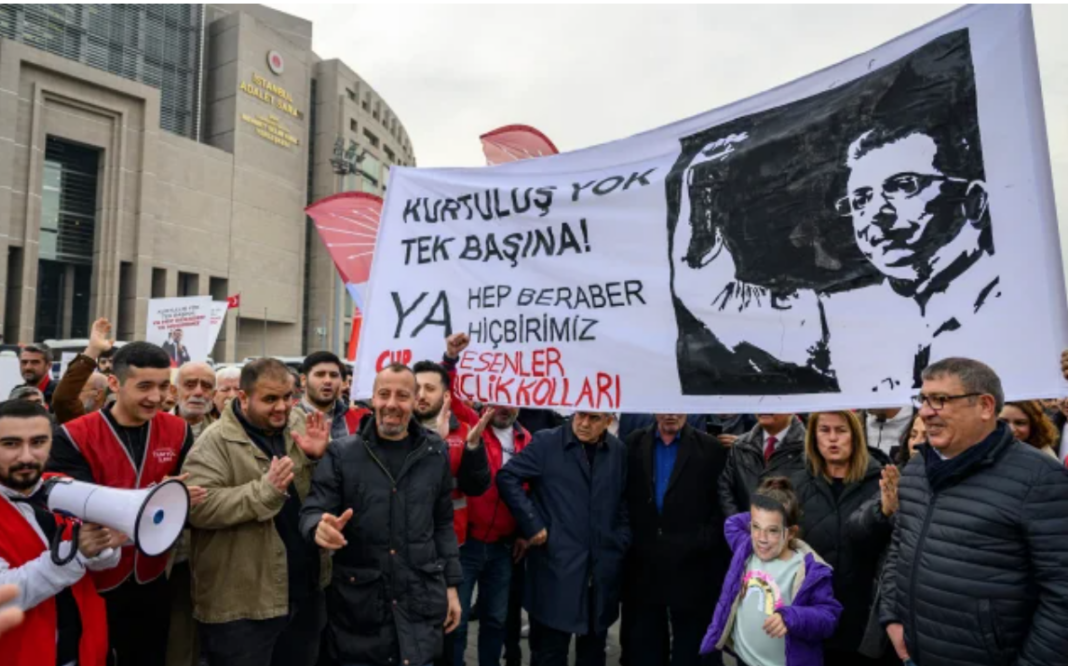
That mutation has already occurred. The detention and jailing of Ekrem İmamoglu, widely seen as the most credible alternative to Recep Tayyip Erdogan, triggered the largest protests Turkey has experienced in over a decade. The state responded with bans, arrests, narrative discipline, and insistence on institutional independence. The shock was not confined to politics. Markets reacted immediately. The currency wobbled. Emergency measures followed. For two decades, Turkey’s strength was not fear but performance: growth, services, predictability, and regular elections. When persuasion gives way to procedural traps and credential warfare, the regime signals doubt in its ability to win openly. In a country exposed to global capital, tourism, and imports, that doubt is punished within hours.
Information controls tightened. Foreign journalists were removed. Domestic broadcasters were fined and suspended. Audiences did not disengage; they rerouted. As the gap between lived reality and official narration widened, it stopped pacifying and began mobilizing. Iran mastered this gap long ago. Turkey is discovering that it can generate momentum rather than suppress it.
There is an external confirmation of this vulnerability, and it lies outside Turkey’s borders but not outside its control: the occupied northern part of Cyprus. Treating the occupied territory as detached from Turkey’s internal dynamics is a persistent analytical error. It is culturally and linguistically close to Turkey, economically dependent on Ankara, and politically subordinate – a pressure gauge rather than a peripheral arena.
When İmamoğlu was jailed, solidarity demonstrations appeared in the occupied area almost immediately, underscoring how Turkey’s internal crisis travels along identity, language, and media networks shaped by decades of control. The controversy surrounding academic credentials – including the revocation of a university diploma linked to institutions operating under occupation – exposed a deeper vulnerability. The occupied territory functions as a space where legality, patronage, and political convenience collide, and where procedural maneuvers that may be normalized inside Turkey become visible and contestable once they spill outward.
At the same time, Turkish Cypriots pushed back against cultural and educational interventions imposed from Ankara. Mass protests against attempts to reshape secular education struck directly at the ideological core of Turkey’s ruling coalition. The dismissive response from Ankara accelerated the effect. When a Turkish-speaking society living under military control openly rejects social engineering, the narrative of natural alignment fractures, and audiences inside Turkey notice.
The ballot box then delivered its verdict. The defeat of Ankara-aligned leadership in the occupied area and the election of a figure identified with recalibration were widely read as a rebuke to imposed policy. The aftermath revealed open disagreement within Turkey’s ruling bloc over what the territory represents. Pragmatism clashed with annexationist rhetoric. When coalitions argue publicly over sovereignty in an occupied territory, they are not projecting confidence. They are exposing strain.
This is why similar unrest may move faster in Turkey than in Iran, even if Iran’s streets appear more dramatic. Iran’s system is engineered to survive without consent. It substitutes coercion for legitimacy and relies on structures built for siege conditions. Turkey’s system still claims consent – courts, elections, legality – even as it bends them. When that claim collapses, the regime loses its most valuable asset: the belief that change is possible without rupture. In Iran, brutality is expected. In Turkey, manipulation feels like theft. That difference compresses timelines.
Turkey also faces a sharper economic feedback loop. Tehran can attribute failure to sanctions and endure scarcity. Ankara is judged immediately. Markets react overnight. Elites recalculate. Loyalists fall silent. Fence-sitters reposition. Administrators plan for continuity without the center. Regimes rarely fall because protesters win confrontations. They fall because insiders decide the future is safer elsewhere.
There is one more asymmetry. Iran’s opposition is courageous but diffuse, allowing fragmentation through tailored pressure. Turkey’s crackdown created a single focal point – a person, a city, an office, and a clear institutional question. That clarity enables coalition-building across ideological lines and converts grievance into alignment.
Iran today is living the currency version of this reckoning. Turkey has already tasted the ballot version. The parallel between Tehran and Ankara is not ideology or faith, but the hollowing of governance into performance – winning the day’s narrative while predictability collapses. When systems lose predictability, societies improvise. They hoard. Withdraw. Strike. Migrate. Mock. Stop cooperating. That is how regimes begin to fall.
Iran’s system may endure this wave because it was built for isolation and coercion, but its survival is not predictable. Moments of internal strain often tempt regimes to look outward, seeking cohesion through confrontation and unity through the demonization of external enemies. Whether such moves stabilize a system or accelerate its decay is never clear. In Turkey’s case, however, further escalation of unrest combined with additional damage to democratic legitimacy would more likely hasten collapse rather than prevent it. It still depends on a functioning economy, a credible claim to legality, and a believable story of consent. Close those exits, and pressure rises faster than fear can contain it.
Originally published in Greek in Geopolitico, a platform powered by Savvas Kalenteridis, as “Τι αποκαλύπτουν οι δρόμοι του Ιράν για το μέλλον της Τουρκίας”. This essay now appears in English in a revised version translated by the author.
About the Author
Shay Gal is a senior strategic advisor and analyst specializing in international security, defense policy, geopolitical crisis management, and strategic communications. He served as Vice President of External Relations at Israel Aerospace Industries (IAI), and previously held senior advisory roles for Israeli government ministers, focusing on crisis management, policy formulation, and strategic influence. Shay consults governments, senior military leaders, and global institutions on navigating complex geopolitical landscapes, shaping effective defense strategies, and fostering international strategic cooperation. His writing and analysis address international power dynamics, security challenges, economics, and leadership, offering practical insights and solutions to today’s global issues.