
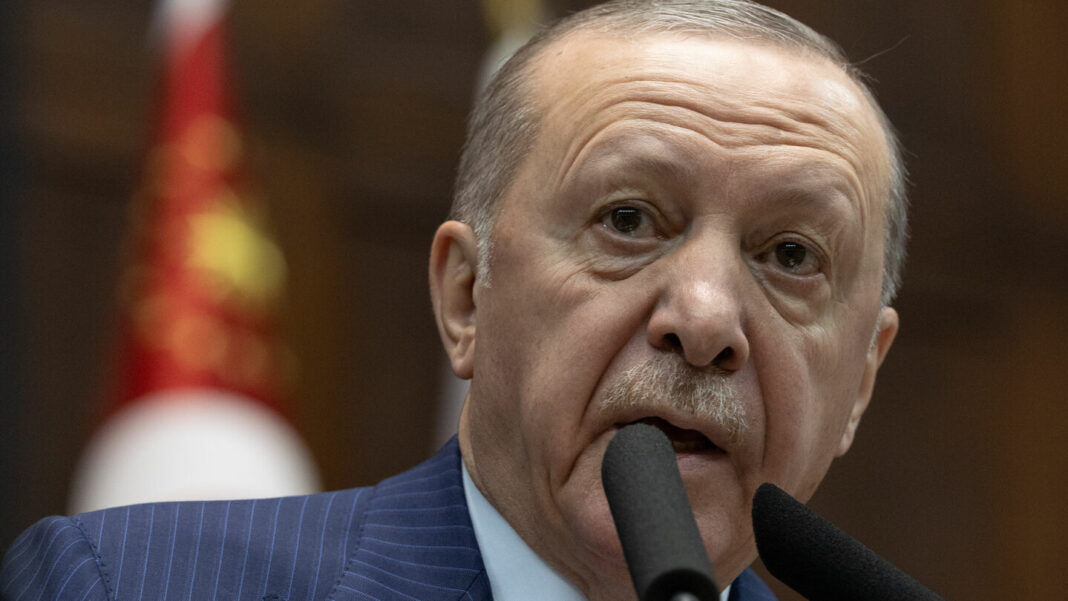

Despite being excluded from Gaza’s international stabilization force, Ankara will likely leverage its ties with Hamas to maintain influence within the Trump administration’s Board of Peace.
Turkey’s current exclusion from the planned international stabilization force for the Gaza Strip may prove a strategic blessing, sparing it from a high-risk military role while maintaining its influence in the Palestinian enclave through political ties and humanitarian engagement.
During Thursday’s Board of Peace meeting in Washington, chaired by US President Donald Trump, Turkey was left out of the proposed international force to be deployed in Gaza despite Ankara’s earlier bid to contribute troops. It seems a setback on paper, diluting Turkey’s influence in post-war Gaza, but analysts say it may ultimately save Turkey from being boxed into an uncertain military mission that could have placed its forces in direct friction with Israel.
Instead, Ankara is expected to lean on its political ties with Hamas and other Palestinian factions to retain influence inside Gaza and within the Trump-led board.
Israel remains opposed to a Turkish military presence in Gaza, fearing that Ankara’s ties with Hamas could complicate the group’s disarmament, a key requirement under Trump’s plan. Turkey is the sole NATO country that doesn’t recognize the militant group as a terrorist organization and Hamas’ political leaders divide their time between Qatar and Turkey.
Relations further plummeted after Hamas’ Oct. 7 attack on Israel as Turkish President Recep Tayyip Erdogan repeatedly referred to the militant group as « freedom fighters. »
Since helping broker a ceasefire in October, Ankara has been seeking a role that could bolster the Turkish government’s standing both internationally and at home, where the Palestinian cause resonates strongly with the public.
Blessing in disguise
During the inaugural meeting of the Board of Peace, a multinational body that will oversee Gaza reconstruction efforts, the ISF’s commander, Maj. Gen. Jasper Jeffers, said five countries will contribute to troop deployment, namely Indonesia, Morocco, Kazakhstan, Kosovo and Albania. Meanwhile, Egypt and Jordan pledged to train police, Jeffers said.
Turkish Foreign Minister Hakan Fidan attended the meeting and reiterated Turkey’s readiness to deploy troops to the enclave during his speech at the ceremony.
Under the second phase of the peace deal, the Israeli military is expected to withdraw from most of Gaza while Hamas is disarmed and the ISF deploys to the enclave before a longer third phase will focus on rebuilding and eventual Palestinian statehood.
According to a UN resolution passed in November, the international stabilization force will work with « the newly trained and vetted Palestinian police force, to help secure border areas; stabilize the security environment in Gaza by ensuring the process of demilitarizing the Gaza Strip, including the destruction and prevention of rebuilding of the military, terror, and offensive infrastructure, as well as the permanent decommissioning of weapons from non-state armed groups. »
“Interestingly, not joining the ISF for now might be to Turkey’s advantage,” Gonul Tol, the founding director of the Turkish Program at the Middle East Institute, told Al-Monitor.
Turkish participation in the stabilization force could quickly become politically toxic domestically. “Without a clear Israeli commitment to withdraw from Gaza, Turkey’s participation in the ISF risks making Ankara look like it is enabling Israel’s Gaza policy,” Tol said.
Tol, however, warned that facts on the ground already make that road map fragile.
“Major obstacles still stand in the way of implementing phase two of Donald Trump’s plan,” she said. “Chief among them: Israel’s entrenched right-wing government and a Hamas movement that, despite Trump’s claims, has repeatedly hedged on whether, when and under what conditions it would disarm.”
To be sure, Ankara’s exclusion has not come without cost. Turkish officials have actively lobbied for a troop role, viewing participation as a way to boost Ankara’s diplomatic weight and reinforce Erdogan’s standing at home, where Gaza has become a significant issue for his support base.
The decision also underscores the limits of Ankara’s influence with the United States. It reflects that while Turkey may retain political and humanitarian leverage, its sway over the hard security architecture emerging under the Board of Peace will be limited without boots on the ground.
Turkey’s remaining leverage
While troop participation would undoubtedly amplify Turkey’s visibility inside the Board of Peace framework, Ankara does not need boots on the ground to maintain leverage over Hamas, Palestinian politics or Gaza’s postwar trajectory.
Turkey will “likely remain an influential actor in any Board of Peace framework and in shaping Gaza’s future, despite Israeli reservations,” Pinar Dost, a nonresident fellow in the Turkey Program at the Atlantic Council, told Al-Monitor.
That assessment was echoed publicly by Trump himself. In remarks reported in October 2025 as he traveled to the Middle East for the signing ceremony of the Gaza peace plan, Trump praised Ankara’s role in advancing the ceasefire. “President Erdogan was fantastic. He really helped a lot,” he said.
Erdogan’s personal rapport with Trump will likely continue to give Ankara a seat at the table as the Gaze ceasefire remains in flux. “When you also include the broader Turkey-US relationship — particularly the chemistry between Trump and Erdogan — the latter is likely to remain an influential actor in any Board of Peace framework and in shaping Gaza’s future, despite Israeli reservations,” Dost said.
Beyond diplomacy, Turkey’s humanitarian footprint gives it another durable lever inside Gaza. Since October 2023, Ankara’s aid campaign, coordinated through state agencies including Turkey’s disaster management agency AFAD and the Turkish Red Crescent and other bodies have delivered more than 100,000 tons of supplies to the enclave, ranging from food and medicine to shelter materials, according to official Turkish figures.