

Ekathimerini.com, December 29, 2025
Greece is attempting to strike a difficult balance between deepening its regional alliances and maintaining the communication channels established with Ankara over the past three years, while closely monitoring Washington’s role as a key power broker in the Middle East and the Eastern Mediterranean. Although the Athens-Ankara-Washington triangle remains central, Israel is increasingly shaping the strategic environment confronting Greek foreign policy.
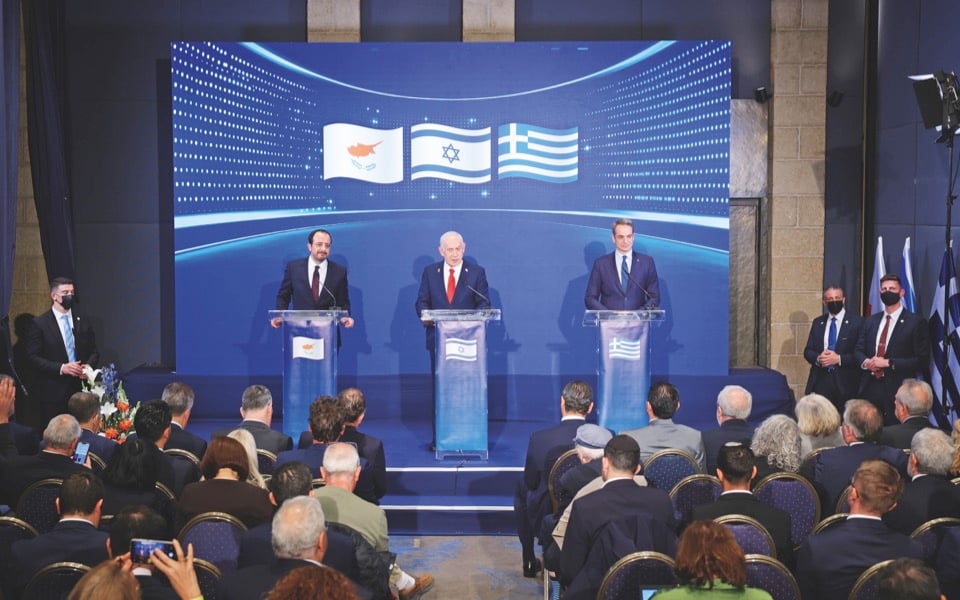
Prime Minister Kyriakos Mitsotakis traveled to Jerusalem last Monday with Cypriot President Nikos Christodoulides, where they met Israeli Prime Minister Benjamin Netanyahu and reaffirmed their commitment to deepening cooperation across several sectors. The trilateral meeting was perceived in Ankara as a revival of an explicitly “anti-Turkish” alignment, particularly as Netanyahu spoke openly against Turkey. For Greece, the immediate consequence was a return to Turkish airspace violations and the first mock dogfight in the northeastern Aegean in nearly three years.
The violations occurred between six and 10 nautical miles of airspace, reflecting a long-standing dispute, as some within NATO regard Greece’s 10-mile airspace limit as an anomaly given its 6-mile territorial waters in the Aegean.
Athens sees these shifting dynamics as part of the region’s wider security architecture. Netanyahu’s visit to Mar-a-Lago and the prospect of a meeting with US President Donald Trump are viewed as significant, with Washington seen as a potential “arbiter” in strained Turkish-Israeli relations, particularly over Syria. Greek assessments suggest Turkey lacks the economic capacity to manage Syria alone, as Saudi Arabia and Qatar expand their influence in Damascus, while Israeli plans would limit Ankara’s control and increase Jerusalem’s regional weight.
Greek officials believe closer alignment with Israel is viewed by Ankara as added Western pressure. However, a full return to the pre-February 2023 climate of tension is considered unlikely. Athens is preparing for limited violations but no major escalation, especially as contentious projects such as the Greece-Cyprus electricity interconnection remain frozen.