
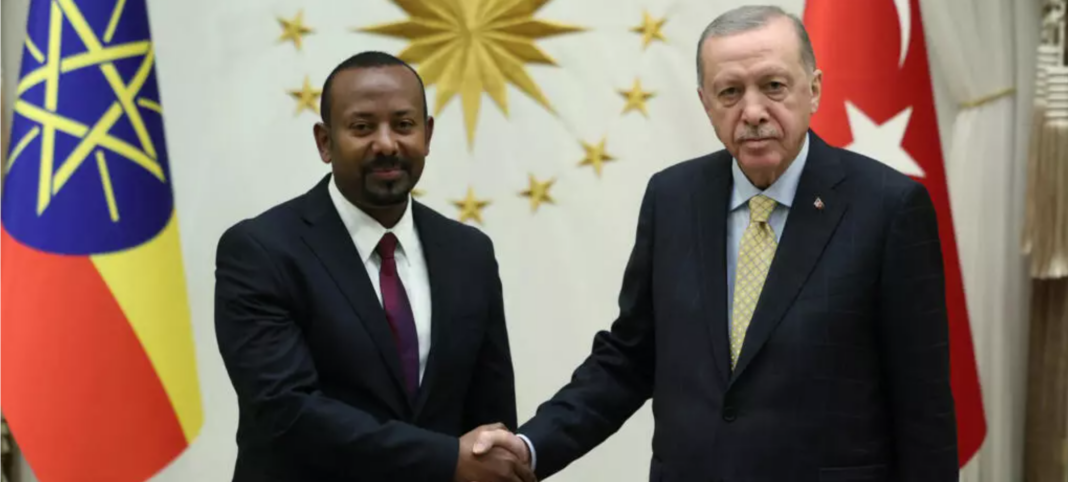

Turkey opposes Somaliland’s recognition to protect its strategic military foothold in Mogadishu and the Red Sea.
ANKARA — Turkish President Recep Tayyip Erdogan cautioned Ethiopia on Tuesday against recognizing Somaliland after meeting Ethiopian Prime Minister Abiy Ahmed in Addis Ababa during his first visit to the Horn of Africa in over a decade.
Details: Erdogan’s visit to the region, his first since 2015, comes as Ethiopia is reportedly mulling whether to follow Israel’s decision to recognize Somaliland, according to regional and Turkish news reports. The Jewish state became the first to recognize the breakaway region in December.
“I would like to particularly emphasize our stance … which values the sovereignty and territorial integrity of states,” Erdogan said during a joint press conference with the Ethiopian leader.
Turkey and Ethiopia also signed several cooperation deals during the visit, including a memorandum of understanding on energy cooperation.
“More than 200 Turkish firms have invested roughly $2.5 billion in Ethiopia, supporting around 20,000 Ethiopian jobs,” Erdogan said on Tuesday during the press conference.
Why it matters: Ankara’s stated concerns come as Ethiopian officials have refused to clarify their position on Somaliland’s autonomy. In late December, Ethiopian Foreign Minister Gedion Timothewos declined to provide a direct answer to parliamentary questions on whether Addis Ababa would follow Israel’s move.
Geeska, a news website based in Somaliland’s de facto capital, Hargeisa, reported on Jan. 12 that Addis Ababa was weighing its options on whether to recognize the region.
Somaliland declared independence from Somalia in 1991 and has operated autonomously ever since, though it remains unrecognized by any other country except Israel.
The European Union, Turkey and a majority of African countries oppose recognizing Somaliland. The Trump administration has said it does not intend to recognize Somaliland’s independence. However, President Donald Trump’s son, Eric, met with Somaliland President Abdirahman Mohamed Abdullahi on the sidelines of the World Economic Forum in Davos in early January.
Read also La Turquie d’Erdogan en mer Rouge
Turkey’s opposition to recognizing Somaliland is closely tied to its strategic footprint in Somalia. The country hosts one of Turkey’s largest overseas military training bases in Mogadishu, giving Ankara a strategic military foothold in the Red Sea. Ankara also provides extensive economic, humanitarian and financial support to the Somali federal government and formally designated Somalia’s territorial integrity a national security priority on Jan. 28.
Background: Addis Ababa previously pledged to recognize Somaliland in exchange for Red Sea access under a deal it signed with the breakaway region in 2024. Somalia, in turn, declared the agreement a cause for war.
Heightened tensions between the two neighbors were later eased through Turkish mediation, leading Ethiopia and Somalia to reach a deal that put Addis Ababa’s recognition of Hargeisa on hold. Under the agreement signed in February 2025, Ethiopia reaffirmed Somalia’s territorial integrity in exchange for prospective Red Sea access via Somali territory. Talks remain ongoing and Ethiopia does not yet have that access.
Landlocked since Eritrea’s independence in 1993, Ethiopia relies on Djibouti for more than 90% of its trade, making Red Sea access a strategic priority.
Know more: Turkey and Ethiopia bolstered defense cooperation in 2021 by signing a military cooperation framework, paving the way for training and procurement. Later that year, Ethiopia acquired an undisclosed number of Bayraktar TB2 armed drones, which it deployed in its war in the northern Tigray region. The Turkish drone sales drew international scrutiny, with rights groups raising concerns over civilian casualties.