

Turkey’s shipbuilding industry could help ease pressure on overstretched US naval yards, though political, technological and financial hurdles make support work more likely than building major US warships.
ANKARA — Turkey’s pitch to help rebuild America’s depleted shipbuilding base could open a new chapter in defense ties between Ankara and Washington, but the most realistic areas of cooperation are likely to be support vessels, maintenance and components rather than frigates, submarines and aircraft carriers.
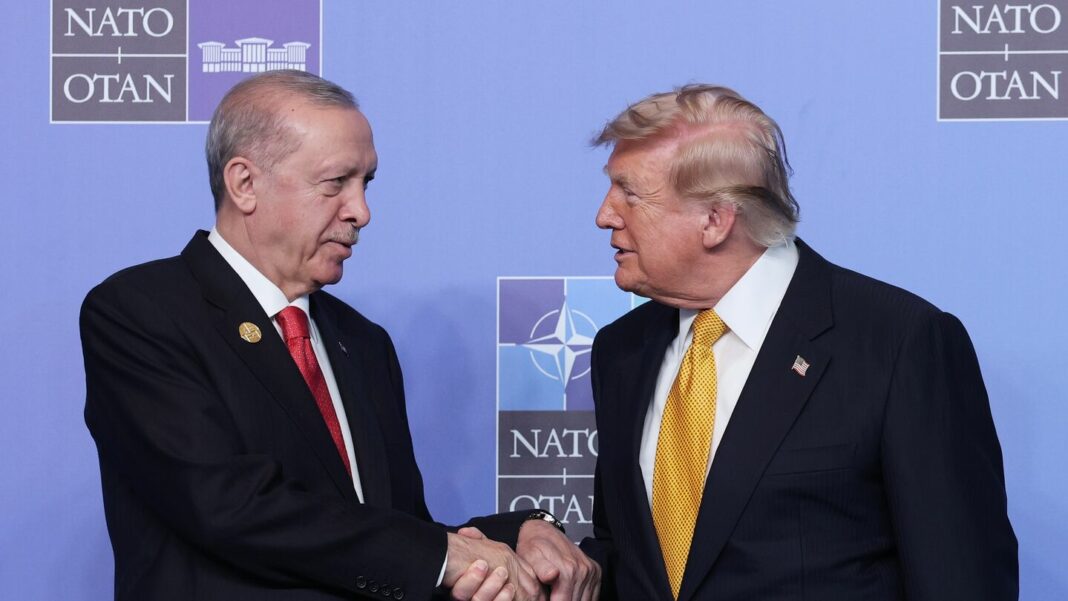
President Recep Tayyip Erdogan’s talks with US President Donald Trump have raised the prospect of Turkish shipyards contributing to Washington’s effort to expand naval production, as American yards struggle with labor shortages, supply chain bottlenecks and persistent delays.
“We specifically discussed the shipbuilding sector, and God willing, we will take rapid steps,” Erdogan said on July 8 during the NATO summit in Ankara. “This could involve frigates, corvettes or submarines. … [Turkey] is fully capable of executing this in its own shipyards,” he added.
In the near term, though, cooperation is more likely to involve ship maintenance, support vessels, components or Turkish investment in US yards rather than the construction of major US warships in Turkey.
According to experts, potential joint production opportunities between Ankara and Washington could take several forms. Turkish shipyards could build support vessels for the US Navy, Turkish companies could invest in or acquire stakes in American shipyards, or the two sides could cooperate on licensed designs, components, maintenance and repair. Building major US warships or submarines in Turkey would be the most politically difficult option.
What Turkey could do for the US
While the United States produced roughly 90% of the world’s ships during and immediately after World War II, its shipbuilding industry has since shrunk. Although US naval shipyards remain among the world’s largest, they struggle to deliver warships and submarines on time and within budget.
The US naval industry is struggling with aging facilities, a limited pool of skilled workers and bottlenecks in the supply of engines, components and other specialized equipment. These constraints have contributed to rising costs and repeated delays, particularly in submarine programs, prompting Washington to consider whether experienced foreign shipbuilders could help expand capacity.
According to a 2023 congressional report, American shipyards produce fewer than five large civilian oceangoing vessels per year, about 0.2% of global output. In March 2026, the Center for Naval Analyses — an independent and nonprofit research center in Washington that also receives funds from the US government — reported that US shipyards put five to six warships and submarines for the US Navy to sea per year, noting that these projects almost always go over budget and fall behind schedule. In comparison, China puts out more than 100 combat vessels and 1,700 oceangoing ships per year.
In a bid to revive domestic production, the United States in 2024 allowed South Korea’s Hanwha group and Italy’s Fincantieri to purchase US shipyards, but underlying US shipbuilding problems remain.
Meanwhile, Turkey produces between 50 to 85 commercial ships and about 10 warships and submarines each year. Nearly 50 military vessels are currently under construction, mostly for the Turkish Navy, according to the website Defence Turk.
According to Turkish naval engineer and independent defense analyst Kozan Selcuk Erkan, potential naval cooperation between Ankara and Washington would likely focus on support vessels, ship maintenance and repair.
“Trump wants to bolster employment and spending at home, and he would not be able to persuade the US public or lawmakers to produce ships in Turkey,” he told Al-Monitor.
Erkan said Turkey’s more realistic opportunity could be in producing replenishment ships and other support vessels, similar to those that Turkish companies have built for the Pakistani Navy, including the PNS Moawin, and are now constructing for the Portuguese Navy.
Turkey already has experience in this field through the country’s state-controlled defense engineering company STM. The company designed the PNS Moawin fleet tanker and oversaw its construction at Karachi Shipyard with Pakistani participation. The vessel, one of Turkey’s largest naval export projects by tonnage, was delivered to the Pakistani Navy in October 2018 and has since served as a fleet logistics-support vessel and flagship.
STM signed a contract with Portugal in December 2024 to build two auxiliary oiler replenishment and logistics ships in Turkey, marking Turkey’s first military-vessel export to a European Union and NATO member.
Construction of the first ship reached the keel-laying stage in January, while production of the second began in June. The multipurpose vessels are designed to transfer fuel and solid cargo at sea while also supporting command-and-control, medical, amphibious, humanitarian and search-and-rescue missions.
What can Turkey gain
A Turkish defense industry official said he was not convinced there was much for Turkey to gain from cooperation with the United States on this front. “Turkey has the capacity to design and produce any ship now,” the official told Al-Monitor on condition of anonymity.
“Whether US orders will come to Turkey is not clear, but if it does, we have the main contractors and engineering firms, as well as shipyards to build civilian and military vessels and a defense industrial ecosystem that could supply any type of system to those vessels,” the source added.
The source also said closer naval cooperation with Washington could nevertheless help Turkey acquire some of the institutional and technical know-how needed to operate longer-range naval forces, particularly as Ankara pursues an indigenous aircraft carrier and considers nuclear-powered submarines.
Ankara publicly confirmed its interest in nuclear-powered submarines in May 2025. Turkish Defense Minister Yasar Guler said in April that preliminary design, feasibility and planning work for a nuclear submarine had begun.
Naval cooperation between Washington and Ankara could include greater Turkish participation in US-led carrier exercises, exchanges involving naval aviation and deck operations, and training in logistics, damage control, submarine rescue, anti-submarine warfare and the maintenance of complex vessels. Turkish and US forces already conduct exercises involving integrated surface, air and subsurface operations, providing an existing framework that could be widened.
For Turkey’s carrier program, exposure to US practices could prove useful in areas such as flight-deck management, aircraft launch and recovery, command-and-control systems and sustaining a carrier group far from home ports.
The nuclear-submarine field would be far more sensitive. Washington tightly controls naval-reactor technology and has agreed to share nuclear-propulsion expertise only with Australia through the AUKUS framework. Cooperation with Turkey would therefore be more likely to begin with nuclear safety, workforce development, port infrastructure, submarine maintenance and operational doctrine than with reactor designs or propulsion systems.
Closer cooperation with the US Navy and US shipbuilding industries would also give Turkey a new level of prestige that it could leverage to expand its global defense sales, which went from $1 billion in 2011 to more than $10 billion in 2025, according to international arms watchdog Stockholm International Peace Research Institute’s 2026 report.
Stiff competition
Could some Turkish companies follow Fincantieri and Hanwha’s example and move some of their production to the United States? The competition will be stiff. On the sidelines of the NATO summit in Ankara, Trump met with South Korean President Lee Jae Myung to discuss ongoing and future partnerships in shipbuilding, The Korea Herald reported on July 8.
Any similar partnership would have to overcome persistent tensions in US-Turkey defense relations. Washington imposed sanctions on Ankara in 2019 over its purchase of Russia’s S-400 air defense system and removed Turkey from the F-35 fighter program.
Trump announced during his July 8 visit to Ankara that the sanctions would be lifted, but the issue remains tied to Turkey’s S-400 system under US law.
Financing hurdles could also pose a problem for Turkish companies, given Turkey’s prolonged struggle with high inflation, elevated borrowing costs and limited access to affordable long-term capital.
By comparison, part of Hanwha’s planned $5 billion investment in the Philly Shipyard is expected to be supported by financing from JPMorgan Chase. It remains unclear whether Turkish companies could secure similar backing from US or international lenders.