

Turkey is seeking to turn the diplomatic momentum from the Ankara NATO summit into a broad defense realignment spanning US sanctions relief and fighter technology, European air defenses and deeper military cooperation with the UK.
ANKARA — Turkey emerged from this week’s NATO summit with a new defense partnership with the United Kingdom and fresh momentum on several other long-running defense priorities, including lifting US sanctions over its Russian-made S-400 system, acquiring US-made jet engines and pursuing the European-made SAMP/T air defense system.
Turkish President Recep Tayyip Erdogan hosted the leaders of NATO’s 31 other member states, including US President Donald Trump, on Tuesday and Wednesday in the Turkish capital, Ankara.
Trump became the first US president to make an official visit to Turkey for the summit since former President Barack Obama in 2015.
In a break with standard protocol, Erdogan personally welcomed Trump at Ankara Airport before receiving him with an official ceremony at the presidential complex.
The two leaders then held bilateral talks in Ankara, during which Trump announced that his administration would move to lift sanctions imposed on Turkey over its purchase of the Russian S-400 defense system and reconsider Ankara’s bid to purchase F-35 fighter jets.
Turkey became the first NATO member targeted under the Countering America’s Adversaries Through Sanctions Act (CAATSA) in 2020 after receiving the first batch of Russian S-400 surface-to-air missile systems in 2019. Under US law, Turkey must no longer possess the Russian systems for the sanctions to be removed.
Trump’s announcement fell short of the immediate breakthrough Ankara had hoped for from the summit, but it nevertheless injected fresh momentum into efforts to resolve the long-running dispute.
The summit also yielded progress on other defense fronts. Turkey signed a new security and defense partnership with the United Kingdom, while France signaled greater openness to a potential sale of the European-made SAMP/T air defense system.
CAATSA talks gain traction
The momentum generated by Trump’s announcement gained further traction on Friday after Turkish columnist Abdulkadir Selvi, who is seen as having close ties to the government, reported in Hurriyet that Ankara was considering selling the Russian-made S-400 systems to the United Arab Emirates or Qatar.
Hours later, the Kremlin confirmed for the first time that it was in contact with Turkey over the fate of the missile systems. Kremlin spokesperson Dmitry Peskov described the matter as “an extremely sensitive issue” but said Moscow and Ankara would continue discussions.
Any Turkish sale or transfer of the systems to a third country would likely require Russia’s approval.
The Trump administration has also intensified efforts to build support in Washington for a formula to resolve the dispute. A bipartisan congressional delegation that visited Turkey on the sidelines of the NATO summit said there had been progress in the talks, though lawmakers cautioned that key details remained unresolved.
Rep. Mike Turner said the information shared with Congress on Turkey’s S-400 system and its potential return to the F-35 program “appear to be promising.” Sen. Jeanne Shaheen, the top Democrat on the Senate Foreign Relations Committee, was more cautious, saying lawmakers still had “questions to answer” about the proposal.
“CAATSA relief seems probable,” Rich Outzen, a retired US Army officer and nonresident fellow at the Atlantic Council’s Turkey Program, told Al-Monitor.
He cautioned, however, that any easing of the sanctions would still depend on Ankara and Washington reaching a mutually acceptable solution on the S-400s that satisfies US legal requirements, as well as on the Trump administration maintaining sufficient support in Congress despite strong opposition from Israel, Greece and lawmakers who prioritize the security concerns of both countries.
Sen. Lindsey Graham (R-S.C.), a close Trump ally and occasional critic of Turkey, also acknowledged the likely congressional resistance earlier this week while saying he was “open to the sale.”
“There may be some pushback in Congress [because of] Turkey’s relationship with Israel,” he told the news outlet Turkiye Today.
The legal question surrounding the removal of the CAATSA sanctions centers on what it would mean for Turkey to “no longer possess” the S-400s, under a provision in the 2021 National Defense Authorization Act governing the termination of the Turkey sanctions.
The law allows the president to lift them only after certifying to Congress that Turkey and anyone acting on its behalf no longer possess or operate the S-400 or a successor system.
Once the sanctions are lifted, Ankara hopes to revive its bid to purchase F-35 fighter jets from the United States.
As part of the US response to the S-400 purchase, Turkey was removed from the international consortium that manufactures the F-35 and was blocked from acquiring the aircraft despite the roughly $1.4 billion it had already paid to buy six F-35s.
According to independent defense analyst Arda Mevlutoglu, any delivery of F-35 fighter jets would depend on clearing several critical hurdles related to the S-400s, foremost among them the question of whether Turkey still legally possesses the Russian systems.
“There is only a very narrow window of opportunity until November,” Mevlutoglu told Al-Monitor, referring to the US midterm elections.
While the summit produced no immediate breakthrough on CAATSA, Ankara has secured a more concrete gain on its domestically developed KAAN fighter jet program. The Trump administration formally notified Congress on June 25 of its intention to sell Turkey more than $700 million worth of General Electric F110 engines, with the proposed package reportedly covering around 80 engines.
Russian S-400 out, European SAMP/T in
The NATO summit also injected fresh momentum into Ankara’s long-running effort to acquire the Franco-Italian SAMP/T air and missile defense system.
Turkish Defense Minister Yasar Guler said in late June that Ankara was evaluating the possible procurement of both the SAMP/T and the US-made Patriot system. Turkey remained open to arrangements involving technology transfer and joint production, he added.
During the NATO summit, French President Emmanuel Macron publicly confirmed that discussions were continuing among France, Italy and Turkey.
“We have work underway on a Franco-Italian basis, along with Turkey, which is technical work and which is continuing,” Macron told reporters on Wednesday following talks with Erdogan.
No final agreement has been announced, and the negotiations remain at an early stage. A potential deal would likely focus on the next-generation SAMP/T and involve Turkish demands for technology transfer and participation in production.
“The SAMP/T purchase would make sense if it is acquired for anti-ballistic capabilities,” Mevlutoglu told Al-Monitor.
He added that the significance of a potential SAMP/T deal extends beyond military capabilities. He said the acquisition would build on Turkey’s deepening defense cooperation with Italy while cementing a broader political rapprochement with France after years of strained ties over Libya, Syria and maritime disputes in the Eastern Mediterranean.
A potential SAMP/T sale to Turkey could become more attractive to all three countries if Ankara were allowed to integrate the system’s Aster missiles into its planned Steel Dome, a multilayered national air defense network designed to link radars, command systems and interceptors against threats at different ranges.
Turkish participation could also help France and Italy expand production of batteries and missiles, an increasingly important consideration as Europe seeks to strengthen its air defenses while reducing its dependence on US- and Israeli-made systems.
Turkey-UK defense pact
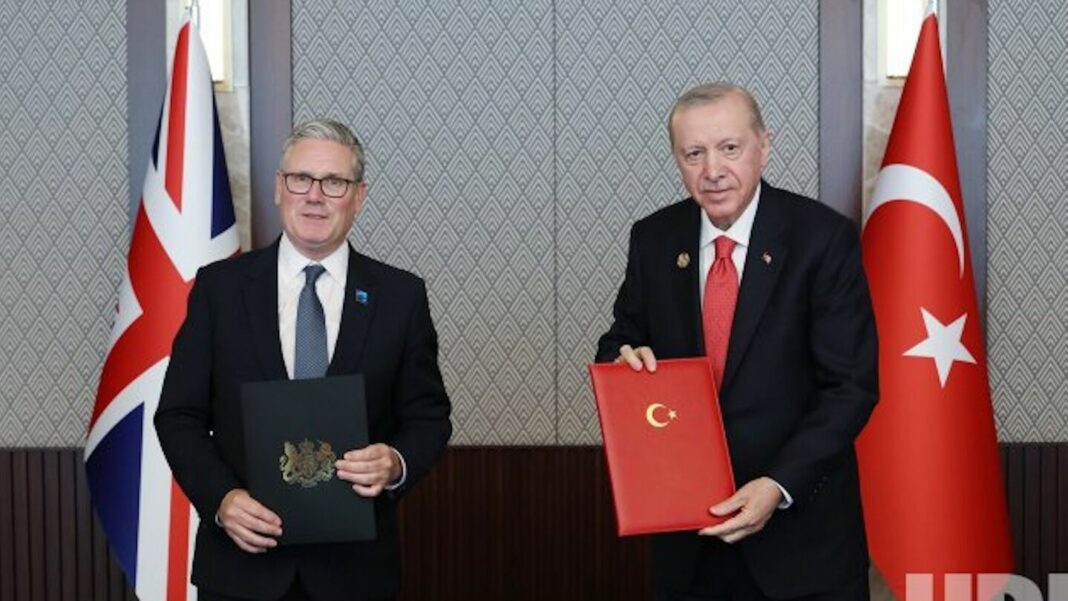
Another critical outcome of the Ankara summit was the signing of a new Turkey-UK defense partnership.
Erdogan and British Prime Minister Keir Starmer signed the document on Wednesday during their bilateral meeting on the sidelines of the summit. In a joint statement, both governments said the agreement would institutionalize cooperation between the two NATO allies through new consultation mechanisms covering deterrence and defense, military cooperation, defense industries and technology, cybersecurity, hybrid threats, counterterrorism, civil preparedness and space.
“The signing of this Partnership reaffirms the UK and Turkiye’s deep commitment to each other’s defense and to the North Atlantic Treaty,” the statement said.
The agreement builds on rapidly expanding defense-industrial ties, including the roughly $9 billion deal signed in October 2025 for Turkey to purchase 20 Eurofighter Typhoon jets, according to the British government.
Turkey is waiting to receive 20 units of the advanced aircraft, the Eurofighter Typhoon. London took a leading role in convincing Germany, one of the four partners in the Eurofighter consortium together with Italy and Spain, to sell the aircraft to Turkey.
“The details have not been disclosed, but the fact that it was signed at all fits a pattern seen over the past five decades: When relations with the United States deteriorate, Turkey moves closer to the United Kingdom as a hedge,” Mevlutoglu said.
Outzen said the summit’s progress across multiple defense initiatives could ultimately help unlock broader Turkish defense exports to Europe and deepen strategic cooperation between Ankara and its European NATO partners, building on already close ties with countries such as Italy, Spain and the UK.
Ultimately, he said, “Trump may serve as an excellent salesman for Turkish defense industries both by praising them and loosening US restrictions to the extent that he can, but also by ruffling European feathers to the point that they seek alternative sources of supply. »