
.)
It was the coup-making generals of 1980 who wrote the foreword to Turkey’s darkening story, by helping to entrench political Islam and paving the way for autocracy through their tragic myopia.
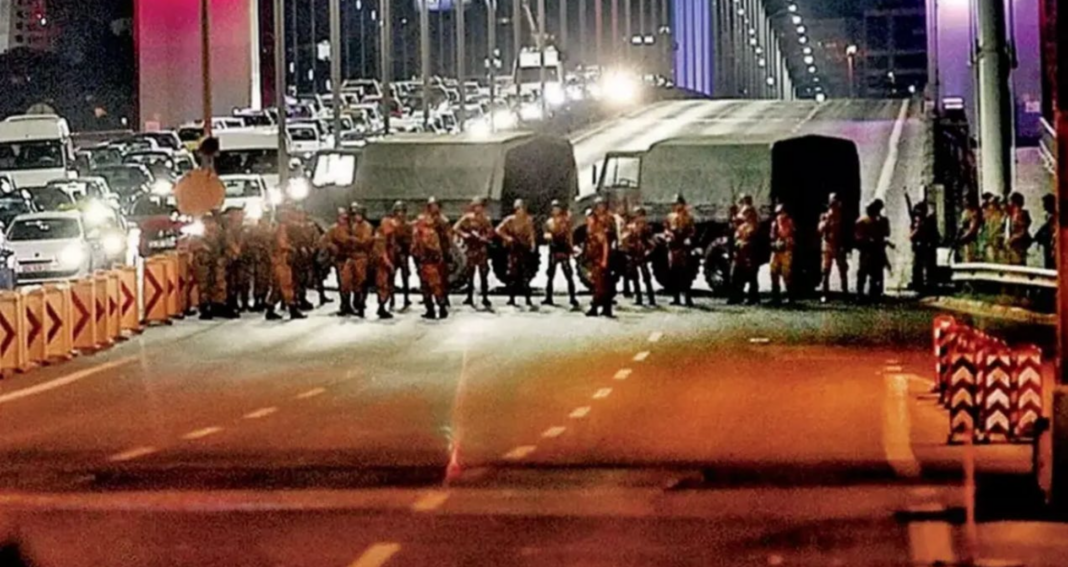
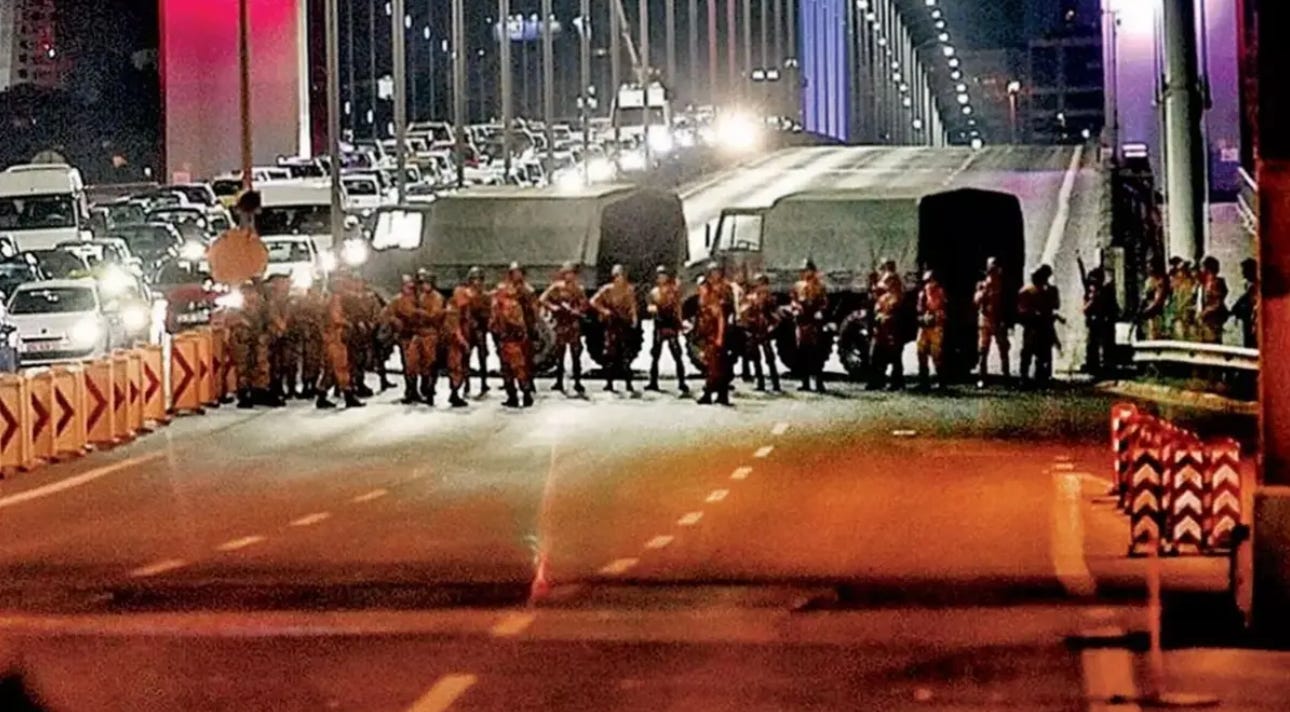
en years have passed since the coup attempt of July 15, 2016, and what was celebrated as the “defense of democracy” became, in practice, the founding myth of Turkey’s slide into a new autocratic order. President Recep Tayyip Erdoğan emerged with a personal victory at the expense of Turkish society, hollowing out the rule of law, crushing the prospects for a functioning democracy, and concentrating power in an executive presidency born under a state of emergency.
The deeper roots of this transformation stretch back to the Cold War, when the military discovered how useful Islam could be as a political instrument against the left and the Kurdish movement. The 1980 coup did not simply interrupt democracy; it helped lay the institutional groundwork for a more durable system of control. The 1982 constitution remains central to this story because it preserved a political order designed to prevent instability while instead reproducing it over decades.
Islam’s value as a political counterweight became increasingly visible to the Turkish military establishment in the later phases of the Cold War, when Sunni conservatism, associated with Necmettin Erbakan and the “Milli Görüş” (“National View”) tradition, was deliberately encouraged as a bulwark against the left.
Mandatory religion courses (which from the outset were mainly about Sunni version of Islam and not much else), introduced after the 1980 coup and entrenched under the 1982 constitution, were part of a broader effort to “nationalize” Islam and channel it through the state’s own apparatus, the Directorate of Religous Affairs, a purely Sunni structure, called “Diyanet”. The junta expanded its budget and remit, reinforcing its role in mosques and sermons and making state-approved religiosity an instrument of social control. It has tens of thousands of Sunni imams across the country as state employees. (All other creeds in Turkey were kept outside, unrepresented in Diyanet.)
At the same time, the generals designed Europe’s highest election threshold, 10 percent, to “stabilize” the party system and keep Kurdish left-wing formations out of parliament. Introduced in 1983, the barrier was justified in the name of order, but it backfired. The religious infrastructure built under military tutelage helped normalize public piety for a generation, while the electoral threshold amplified the seat share of any party able to cross it.
In November 2002, the Justice and Development Party (AKP) won just over 34 percent of the vote but secured around two-thirds of the seats because sixteen parties representing more than 45 percent of voters failed to enter parliament. The junta’s tools, designed to discipline society and marginalize Kurdish and Islamist currents, ended up delivering an Islamist-rooted party a commanding majority and the opportunity to remake the state.
For years, the standard global narrative cast the Turkish Armed Forces as the secular guardian and Erdoğan as the Islamist challenger. But over time, that binary eroded. In the second half of the AKP era, roughly from 2014 to 2023, a new alliance of convenience emerged between the presidency and key segments of the officer corps and security bureaucracy. As Erdoğan consolidated power, launched mass trials against alleged coup plotters, and restructured the chain of command, the top brass adapted to a reality in which their interests were better served by managing him than confronting him.
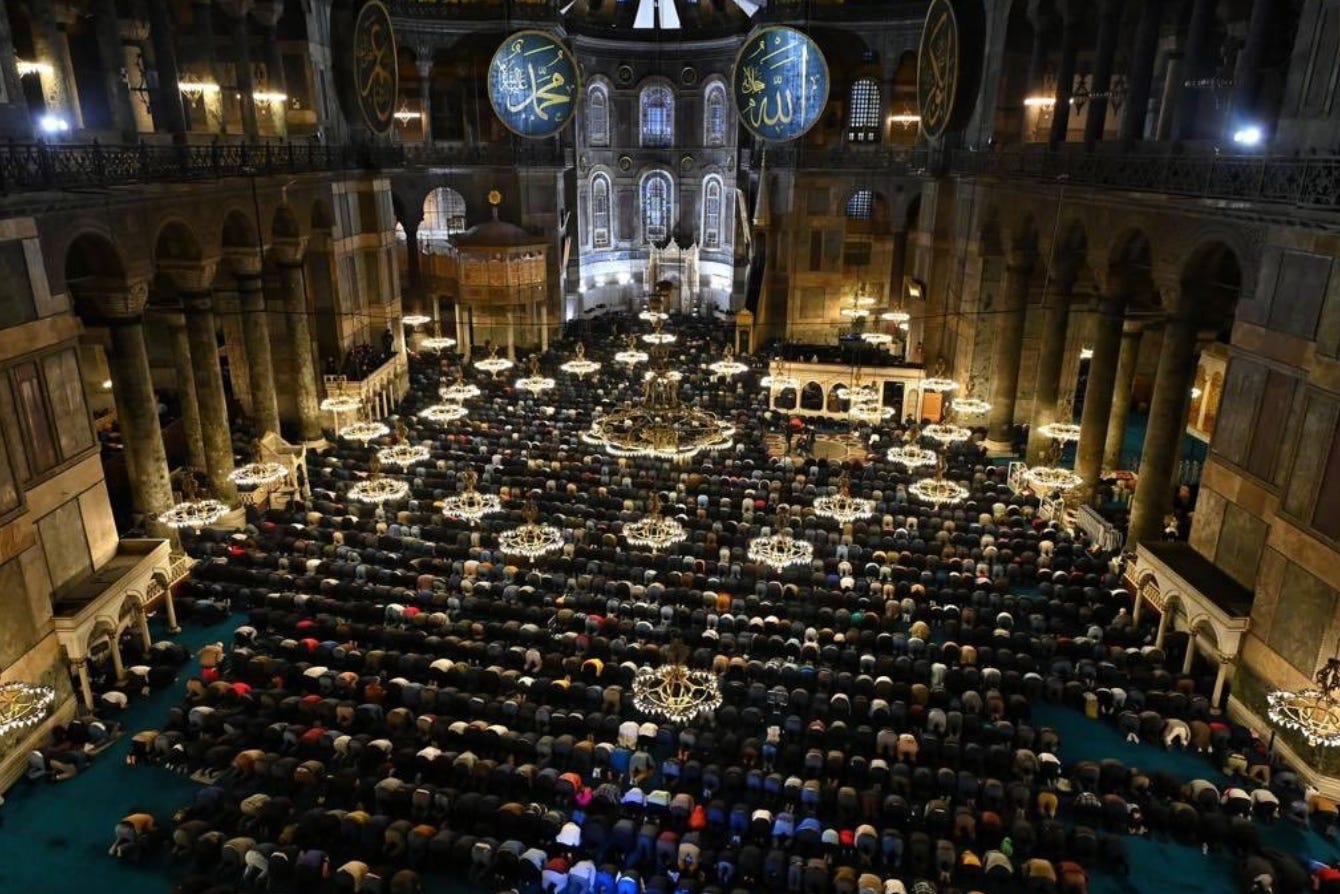
A telling example is Hagia Sophia: Turkey’s generals, long cast as the guardians of the republic’s secular order, did not utter a word when Erdoğan overrode the legacy of Atatürk and turned the monument from a museum back into a mosque in 2020. Yet it was Atatürk himself who had designated Hagia Sophia as a museum in 1934, making its reconversion not just a symbolic break with the founding republic but also a revealing test of the military elite’s professed commitment to secularism. Their silence exposed a deep hypocrisy at the top of the Turkish state, where the rhetoric of guardianship has too often collapsed into selective caution and political convenience.
This convergence produced a state project that keeps Turkey in diplomatic limbo: simultaneously a friend and a foe of the West, indispensable inside NATO yet unpredictable. The clearest symbol was the purchase of the Russian S-400 air-defense system, which triggered Turkey’s expulsion from the F-35 program and U.S. sanctions, even as Ankara defended the decision as a sovereign choice that would not be integrated into NATO networks.
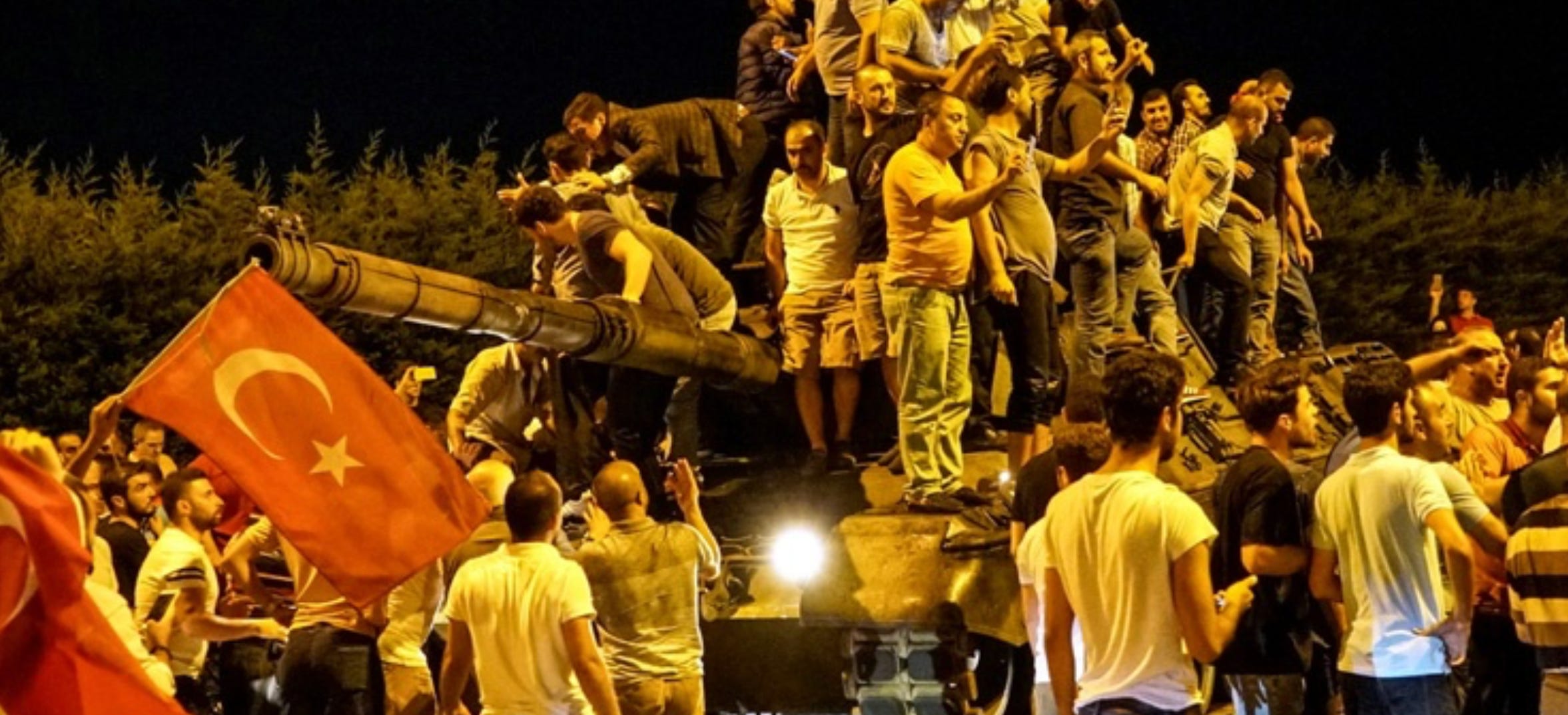
The failed coup attempt of July 15, 2016, became the decisive turning point. The night itself was chaotic and involved different factions, but its outcome was a clear victory for Erdoğan’s camp and for the bureaucracy that chose to stand with him.
When I recently interviewed Ömer Faruk Gergerlioğlu, a deputy of the pro-Kurdish DEM Party and a human-rights defender, a striking picture emerged. Gergerlioğlu was the only deputy who insisted on probing the deeper background of the coup attempt. Defying the official narrative that it was solely the work of the Gülen movement, he visited prisons and spoke with dozens of senior officers accused of plotting the putsch.
What he told me suggested a narrowly contained uprising marked by a chaotic choreography of betrayals, deceptions, informants, and defections. As chaos reigned in the streets, officers from different backgrounds — Kemalists, ultra-nationalists, social democrats, and “Gülenists” — were involved in what resembled nearly a Nazi-style “night of the long knives” mise-en-scène. In other words, the army was undergoing a historic metamorphosis, and the botched coup appeared as its powerful symptom.
Under the state of emergency declared days later, the picture became clearer. The government bypassed parliament, ruled by decree, and launched vast purges across the civil service, judiciary, military, education system, and media. By mid-2017, more than 100,000 public employees had been dismissed or suspended, over 50,000 people were in pre-trial detention, and nearly 3,000 judges and prosecutors had been sacked, many of them jailed. Nearly 25,000 officers were dismissed, including 150 generals. (At that time, there were a total of 348 generals in active duty).
Hundreds of media outlets and associations were shut down, universities were closed, companies were seized, and emergency decrees permanently altered the institutional landscape.
The coup also gave momentum to Erdoğan’s longstanding project to replace Turkey’s parliamentary order with a hyper-presidential one. In April 2017, a “hurried” and narrow referendum, with around 51 percent voting “yes,” approved constitutional reforms that concentrated executive power in the presidency, weakened parliament, and abolished the office of prime minister. Most provisions took effect after the 2018 elections, locking in one-man rule under a framework justified by the need for “strong leadership” amid coup threats and regional turmoil.
The initial response to the coup — mass mobilization, defense of elected institutions, and removal of conspirators — was widely seen as justified. But it quickly became a process through which Erdoğan reshaped the very DNA of the republic’s institutions. Emergency rule normalized the suspension of basic safeguards. Decrees were used not only against those genuinely implicated in the coup but also to restructure institutions wholesale, purge critics, and cement partisan control over the judiciary, security forces, and regulatory agencies.
The atmosphere of permanent threat also helped neutralize political opposition and weaken social resistance. Once dissent could be cast as complicity with “terrorism” or coup plotting, the cost of contestation rose sharply for ordinary citizens, civil servants, journalists, and local politicians.
The result was a politics increasingly organized around the “will of Erdoğan,” not the will of the people. Power was concentrated under the guise of defending the republic, but what actually expanded was personalized rule, built on loyalist networks and emergency-born patronage. Erdoğan also cultivated the image of a defiant national leader who can mobilize crowds at will, project strength abroad, and force global actors — from the EU to NATO partners — to play by his rules. This was visible in his use of veto power and delay inside NATO on issues such as Sweden’s accession and defense planning, extracting concessions while denouncing Western double standards.
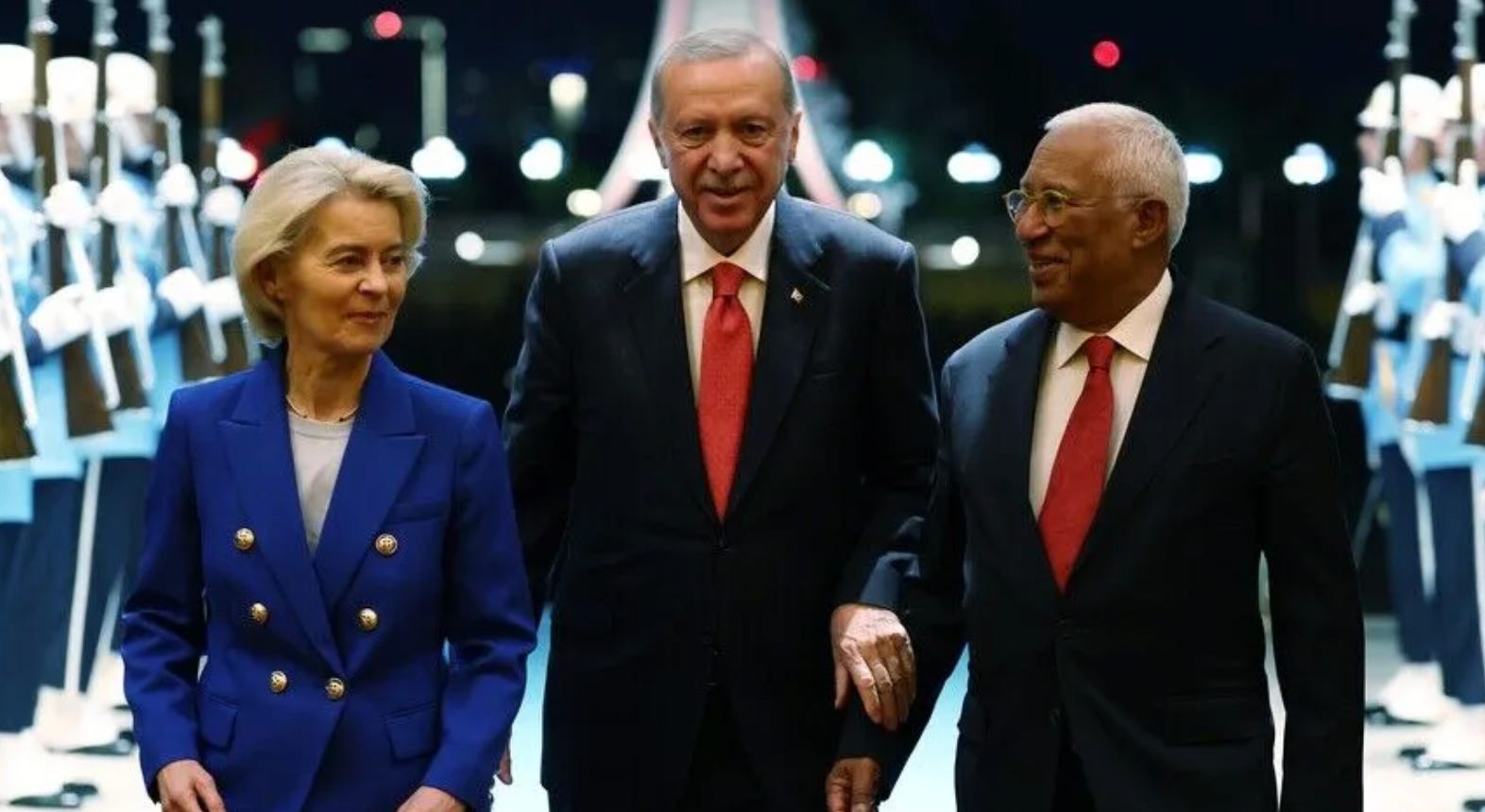
For many Western policymakers, dealing with Erdoğan has often been treated as a “bon pour l’Orient” bargain: a difficult but necessary partner whose domestic authoritarianism can be tolerated in exchange for cooperation on migration, counterterrorism, and regional stability.
But the arrangement has not been a real win-win. Erdoğan has used this permissive environment to stage a diplomatic choreography based on playing conflicting sides against one another. Turkey keeps open channels with Russia, participates in NATO missions, and at the same time frequently escalates disputes with Greece over maritime boundaries, airspace, and hydrocarbon exploration in the Aegean and Eastern Mediterranean.
In the Eastern Mediterranean, Ankara has pushed maximalist claims through controversial maritime agreements, such as the 2019 delimitation deal with Libya, and through draft bills seeking to formalize Turkish jurisdiction over wide areas of sea in direct conflict with Greek and Cypriot positions and EU law. Turkish exploration and drilling in contested waters have prompted repeated naval standoffs and fed the domestic narrative of “Blue Homeland.”
Turkey has also kept channels open to China and shown interest in Belt and Road projects, without aligning unequivocally with Western positions on Russia’s invasion of Ukraine or sanctions regimes. This hedging has strategic logic for Ankara, but it means that Western tolerance of domestic authoritarian consolidation has not bought real alignment on hard-security or normative questions. If democracy and security are inseparable, then treating Erdoğan’s dominance as the price of keeping Turkey “on side” has clearly tilted the balance toward his concentration of power.
Ten years after the coup attempt, the central issue is not only Erdoğan’s power but the shrinking space for the will of Turkey’s citizens as an independent political force. The challenge for both domestic opposition and international partners is to rebuild that space without undermining legitimate security cooperation.
Inside Turkey, that means insisting on constitutionalism and local democracy even under adverse conditions: defending municipal autonomy, supporting independent bar associations, journalists, and rights groups, and building coalitions that cross secular-religious and Turkish-Kurdish divides rather than reproducing old binaries. The aim should not be to romanticize opposition, but to preserve the possibility of plural politics in a system increasingly designed to suffocate it.
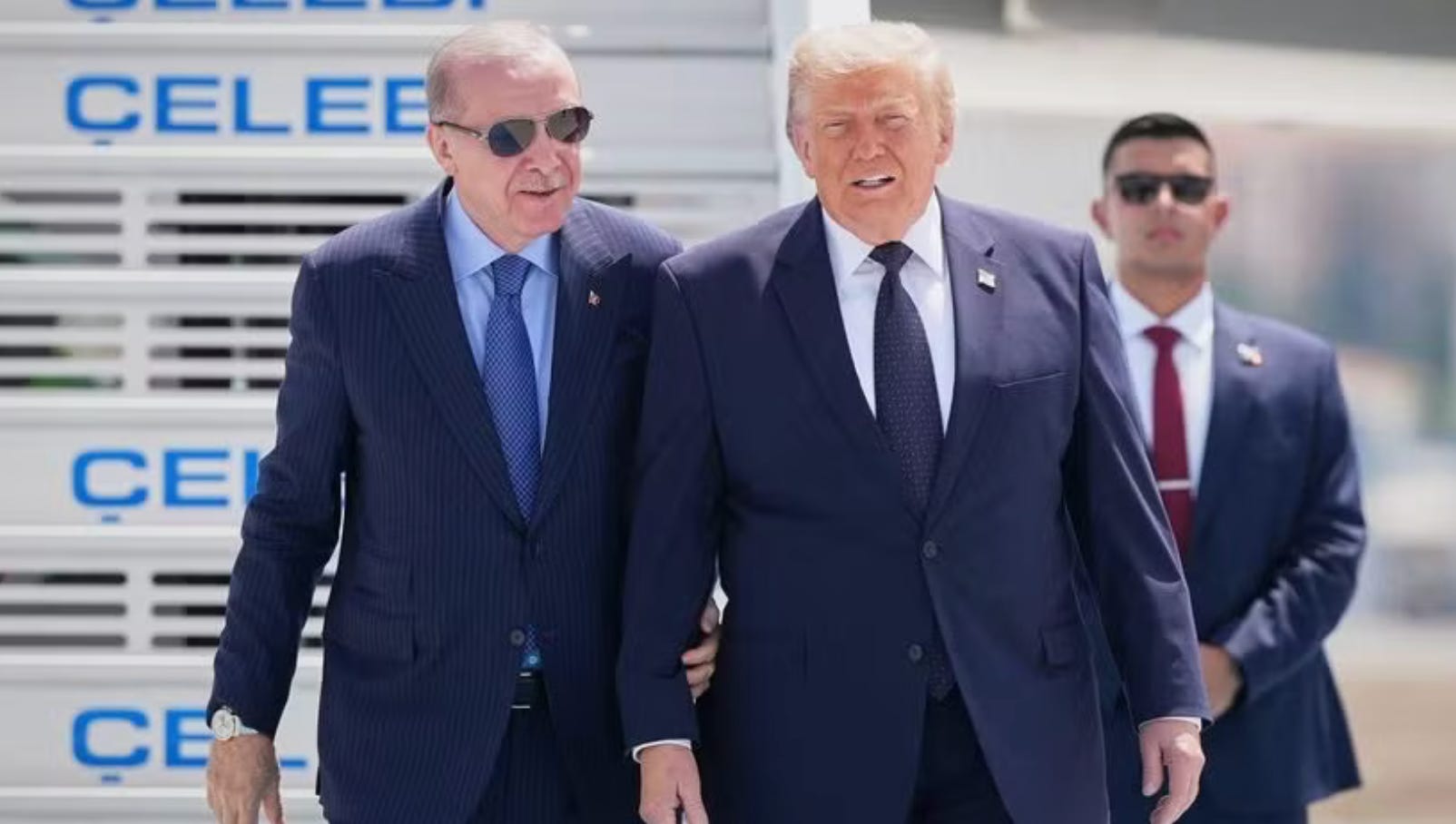
For the EU and NATO, it means abandoning a purely transactional reading of Turkey as a problem to be managed. Cooperation where necessary — on Black Sea security, energy corridors, and migration — should be linked transparently to human-rights benchmarks and rule-of-law standards, rather than left to ad hoc summit bargains. Judicial independence, freedom of expression, and fair elections should be treated not as secondary “values issues” but as core security interests. A Turkey whose institutions are hollowed out by personalized rule is a fragile partner, whatever short-term deals may suggest.
Ultimately, reclaiming space for the will of the Turkish people requires recognizing that the coup attempt was not only a chapter in Erdoğan’s heroic narrative but also a trauma that was instrumentalized to reshape the republic’s DNA. A decade on, the choice is no longer between secular generals and an elected Islamist leader, but between a deeply personalized, militarized system in diplomatic limbo and the possibility — still present in society — of a Turkey that can reconcile pluralism with genuine democratic governance.
The West’s task is not to choose Erdoğan and the system he has built around his persona, or his opponents; but to stop confusing his victories with Turkey’s fate and to structure its relations in ways that finally respect the country’s citizens as political subjects in their own right.