
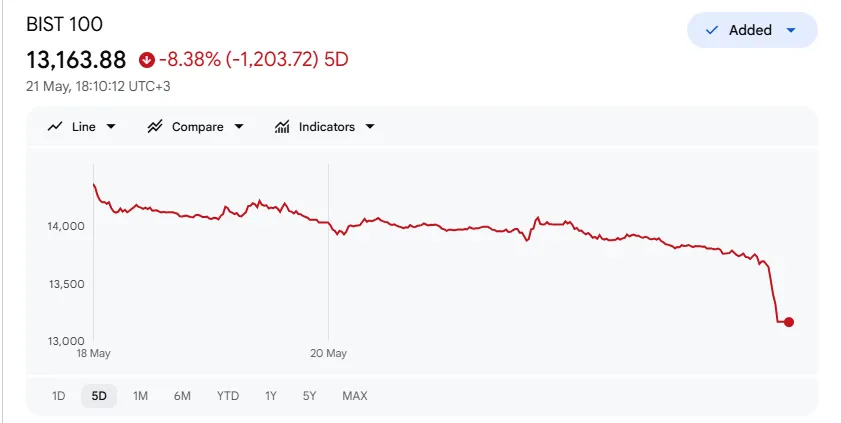

The CHP decision marks a dangerous turning point: the political field is being narrowed further, while the government still has to maintain the fragile confidence of financial markets.
The Turkish court’s decision to remove the leadership of the main opposition party, the CHP, will likely mark another critical turning point in Turkey’s authoritarian consolidation. The issue will be discussed from many angles, but here I want to briefly summarize its likely economic consequences and say a few words about the possibility of early elections.
1. The first effect: stock market decline and capital outflows
We should recall what happened after 19 March 2025. Political interventions of this kind usually trigger an initial sell-off in the stock market, upward pressure on the exchange rate, and foreign capital outflows. The first few hours already showed similar signs.
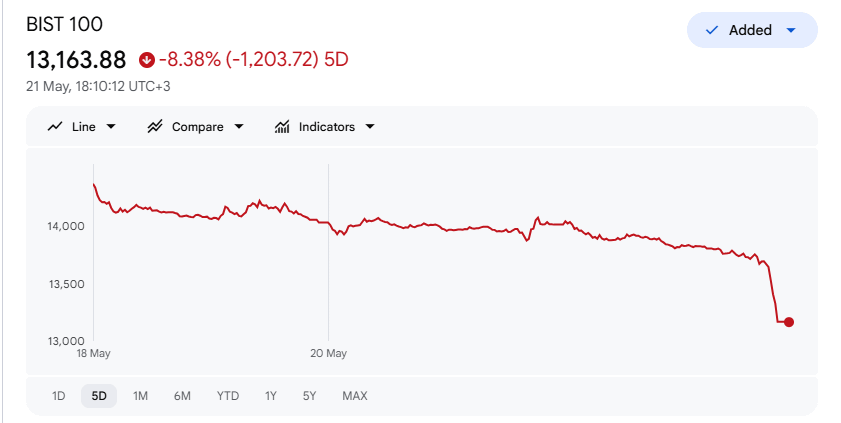
2. A de facto or formal interest rate hike may follow
If market pressure intensifies, pressure on the Turkish lira may also increase. In that case, the economic administration may further tighten liquidity and try to defend the lira through a direct or indirect interest rate hike. This was precisely the sequence observed during the Istanbul Metropolitan Municipality operation in 2025.
3. Pressure on the Central Bank’s reserves will increase
The uncertainty created by the Iran war had already forced the authorities to rely on gold reserves and sales of US Treasury bonds to stabilize the lira. With external pressures already mounting, a domestic political shock could make reserve management even more difficult.
4. The inflation target is now under greater threat
The Central Bank’s year-end inflation target had already become unrealistic. If the exchange-rate channel and inflation expectations deteriorate again, little may remain of the government’s claim that inflation is being brought under control, unless another interest rate hike follows.
5. Early elections?
The government is trying to advance authoritarian consolidation by narrowing the political space, while also preserving the appearance of financial stability. In this context, partial restrictions on access to foreign exchange, reserve management, high interest rates, and credit controls may become the main instruments of crisis management, as in previous episodes.
There is no automatic force pushing the government toward early elections. Under current economic conditions, calling an election would likely be among the last options for the ruling bloc. Expecting an election before 2027 would therefore not be realistic.
In short, the expectation that “markets will not allow” authoritarian consolidation is misplaced. We have seen this before, and it remains valid today: market reactions alone do not trigger political change. Without falling into “liberal fatalism”, we need to recognize that this process can only be pushed back through social and political struggle.