
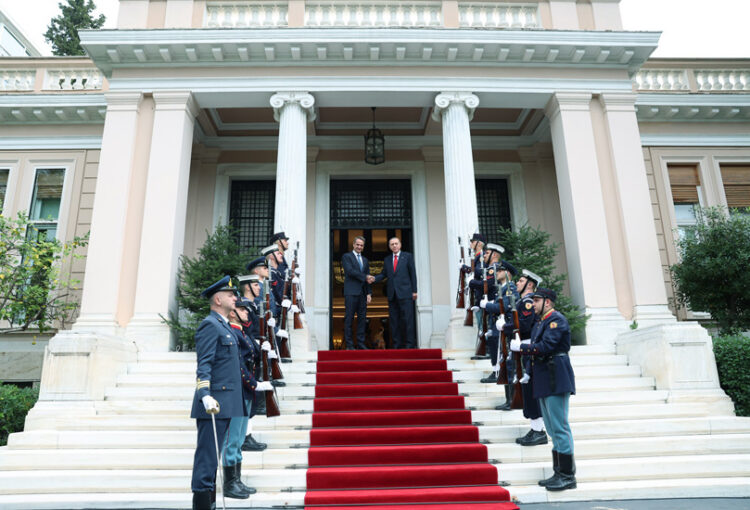

The Turkish government has postponed parliamentary action on a controversial maritime jurisdiction bill associated with the country’s “Blue Homeland” doctrine, delaying a measure that could intensify disputes with Greece and Cyprus while avoiding a potentially divisive debate ahead of next month’s NATO summit in Ankara.
The legislation, widely known in Turkey as the “Blue Homeland Law,” seeks to codify the country’s maritime claims and legal standards regarding exclusive economic zones, continental shelf boundaries and other areas of maritime jurisdiction in the Black Sea, Aegean and eastern Mediterranean. Turkish officials and government-aligned commentators have described the proposal as an effort to bring longstanding maritime claims into domestic law.
The bill was initially expected to reach parliament in May. Turkish officials now indicate that the proposal is likely to remain on hold until at least October because it has not been incorporated into the parliamentary calendar before the legislature’s summer recess. Turkish officials have publicly framed the delay as a matter of scheduling and bureaucracy rather than a policy reversal.
The postponement comes at a sensitive diplomatic moment. Turkey will host NATO leaders in Ankara in July, putting President Recep Tayyip Erdogan at the center of alliance diplomacy during a period marked by the war in Ukraine, instability in the Middle East and growing uncertainty in transatlantic relations.
Avoiding a new dispute with Greece before the summit appears consistent with Ankara’s immediate diplomatic priorities. The legislation has not been abandoned and preparations in Turkish state institutions are continuing. Instead, officials are presenting the delay as a temporary postponement while parliament focuses on other legislative business before its summer break.
The distinction matters because the proposal remains politically significant. The Blue Homeland doctrine has evolved from a naval concept into one of the most recognizable themes in Turkey’s strategic discourse. Supporters describe it as a framework for defending Turkish maritime rights and access to energy resources. Greece and Cyprus view the doctrine as a direct challenge to their own claims in the Aegean and eastern Mediterranean.
The legislation would provide a legal framework for maritime boundaries, exclusive economic zones and disputed geographical features that have long been sources of friction between Turkey and Greece. Draft proposals have also included provisions addressing the legal status of islands, islets and rock formations in areas that both countries claim.
The timing of the delay reflects broader changes in Turkey’s foreign policy environment. Over the past several years Ankara has normalized relations with several regional rivals and shifted away from some of the confrontational diplomacy that defined earlier periods of Erdogan’s rule. The transformation of the regional landscape following developments in Syria has also reduced one of the most significant external issues that had dominated Turkish politics for more than a decade.
As a result disputes involving Israel and the Greek-Cypriot maritime question increasingly stand out among the remaining foreign policy issues capable of generating strong nationalist sentiment at home.
That political dimension helps explain why the legislation remains relevant despite its postponement.
Erdogan has repeatedly used forceful rhetoric regarding disputes with Greece. During periods of heightened tension, he warned that Turkey could take action against perceived threats and famously declared that Turkish forces could arrive “suddenly one night,” comments widely interpreted as directed at Greece during a period of escalating disagreements in the Aegean.
Yet Erdogan has also shown a willingness to soften his position when broader diplomatic interests required de-escalation.
Ahead of a visit to Athens in late 2023, he praised Greek Prime Minister Kyriakos Mitsotakis, emphasized dialogue and cooperation and argued that differences between the two NATO allies could be resolved through diplomacy. He also distanced himself from interpretations that his earlier remarks had constituted direct threats against Greece.
The episode illustrated a recurring feature of Erdogan’s foreign policy approach: nationalist rhetoric during periods of political pressure followed by pragmatic accommodation when strategic circumstances demand it.
That pattern may become increasingly important as Turkey gradually moves toward its next electoral cycle.
Although national elections are not expected immediately, political calculations are already shaping long-term strategy in Ankara. The Turkish economy remains fragile despite signs of stabilization. Inflation, the high cost of living and concerns about household purchasing power continue to dominate public discussion.
For Erdogan those economic realities present a political challenge. The president has maintained a dominant position in Turkish politics and continues to exercise extensive influence over state institutions. Opposition politicians, journalists and critics have faced increasing judicial and political pressure in recent years. Yet economic conditions remain one of the few issues capable of cutting across ideological divisions and generating sustained public dissatisfaction.
Foreign policy disputes offer an alternative political agenda. Unlike inflation or unemployment, sovereignty disputes allow the government to frame itself as the defender of national interests against external pressure. The Blue Homeland legislation fits naturally into that narrative because it combines questions of territorial rights, national identity, military power and energy security.
The bill’s postponement, therefore, should not be interpreted as evidence that Ankara has abandoned the initiative. Instead, the government appears to be waiting for a more favorable moment.
Several factors are likely influencing that calculation. One is the desire to avoid controversy during the NATO summit, where Turkey will seek to present itself as a constructive and indispensable member of the alliance. Introducing a highly contentious maritime law in the weeks leading up to the gathering could draw unwanted attention from allies already concerned about tensions in the eastern Mediterranean.
Another consideration is Turkey’s ongoing defense discussions with European partners. Ankara has been pursuing talks related to the Franco-Italian SAMP/T air and missile defense system as part of its broader effort to strengthen national air defense capabilities. Maintaining productive relations with European governments is important for those negotiations and for Turkey’s wider defense-industrial ambitions.
The European Union remains Turkey’s largest trading partner and a major source of investment. Despite periodic political disputes, Ankara has continued to seek closer economic engagement with Europe. A prolonged confrontation with Greece could easily spill into broader discussions about Turkey’s relationship with the EU at a time when economic stability remains a central government priority.
For that reason Turkish officials appear to be balancing competing objectives: preserving a potentially valuable political issue for the future while avoiding immediate diplomatic costs.
The strategy carries relatively little downside from the government’s perspective. By delaying rather than withdrawing the bill, Ankara can signal continuity to nationalist constituencies while reducing short-term friction with allies and economic partners.
The legislation can then be revived later if circumstances change.
Should relations with Greece deteriorate again or should Ankara conclude that domestic political conditions favor a more assertive foreign policy posture, the Blue Homeland bill would already be prepared and waiting. Any strong reaction from Athens could reinforce the government’s argument that Turkey is defending legitimate maritime rights against external opposition.
For now, however, Erdogan appears focused on a different objective, which is keeping a potentially explosive issue off the international agenda until after the NATO summit and other diplomatic priorities have been passed.
The bill may be delayed, but by most indications it remains very much alive. And as Turkey edges closer to future elections, the political appeal of turning maritime disputes into a national campaign issue is unlikely to disappear.